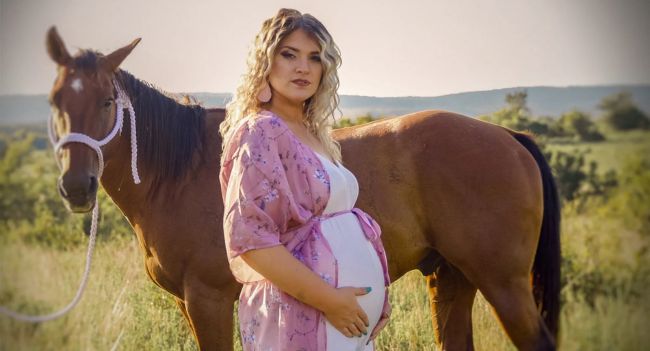
Jessica Dimmock, director of Maternal Instinct, argues that society often overlooks certain types of offenders. “A pretty blonde girl in Texas with a Southern drawl and no violent history isn’t what you think danger looks like in our society,” she says. Released on Netflix last week, the documentary recounts the disturbing case of Taylor Parker, who in 2020 pretended to be pregnant before murdering Reagan Simmons-Hancock and taking her unborn child. The film has since climbed to the top spot among movies on Netflix in the United States.
Maternal Instinct is the second recent Netflix true crime documentary centered on a female perpetrator to gain significant attention online. Another example is The Crash, which examines the 2022 high-speed collision involving Mackenzie Shirilla, who was 17 at the time. The crash, which occurred at nearly 100 miles per hour, resulted in the deaths of Dominic Russo and Davion Flanagan. Following its May 15 debut, the documentary stayed in Netflix’s U.S. Top 10 through June 8, inspired more than 28,000 TikTok videos, and generated frequent media coverage.
Parker and Shirilla join a growing list of women featured in Netflix true crime productions. Earlier this year, The Investigation of Lucy Letby focused on the British neonatal nurse convicted of killing seven infants. Later this year, the first female-led season of Ryan Murphy’s Monster will spotlight Lizzie Borden, who was acquitted in the notorious and still-unsolved 1893 axe murders of her parents.
If a male criminal archetype can be described as a “Dirty John,” then female counterparts might be called “Dirty Janes.” Examples include Gypsy-Rose Blanchard and Michelle Carter, both of whom have completed prison sentences connected to widely publicized cases. Blanchard served time for second-degree murder, while Carter was convicted of involuntary manslaughter. More recently, Karen Read, who was acquitted in June of charges related to the death of her Boston police officer boyfriend, and Sherri Papini, who served time after orchestrating her own 2016 kidnapping in California, each appeared in documentaries about their respective cases.
The popularity of such content reflects the broader growth of true crime media, which has developed into a round-the-clock, multibillion-dollar industry. According to Time, women drive much of that audience, making up nearly 75% of true crime podcast listeners. Data from YouGov similarly indicates that 61% of women watch true crime content, compared with 52% of men. As Time noted in 2020, “They may also relate to the subjects of most true crime entertainment, in which the victims are overwhelmingly female,” while also observing that “even though, in the US at least, far more men than women are murdered each year.”

If women are often drawn to true crime because stories of female victims can serve as cautionary lessons or survival guides, cases involving female perpetrators raise a different question: what makes those stories compelling? According to The Crash director Gareth Johnson, female offenders remain relatively uncommon. “The female perpetrator is much, much rarer. Violence, aggression very traditionally has been considered a masculine characteristic,” says Johnson. “It’s quite possible that there’s an extra layer of interest because of that.” Even so, he did not anticipate the level of attention Shirilla’s case would attract online. “We had a sense it would start debate,” says Johnson, “but I underestimated the intensity of it. It’s been quite wild on social media.”
Since the documentary premiered on Netflix a month ago, audiences have closely examined nearly every aspect of Shirilla’s case. Now 21 years old, she is serving two concurrent prison sentences of 15 years to life, with her first parole hearing set for September 2037. During her trial in August 2023, prosecutors maintained that what initially appeared to be a devastating car crash was, in fact, a deliberate effort by Shirilla to kill Russo following a turbulent relationship. Her social media activity was introduced as evidence supporting the prosecution’s case. Johnson noted how the digital footprint people leave behind increasingly shapes criminal investigations. “People document everything about their lives now, every emotional up and down. And it just changes everything about a criminal investigation,” he says. “If this exact same event happened 10, 15 years ago, it’d be a very, very different story.”

Users on social media, especially on platforms with large female audiences such as TikTok and Instagram, have closely examined Mackenzie Shirilla’s past, including her prison disciplinary history and recorded jail phone conversations with her mother. In one call obtained by TMZ, Shirilla expresses frustration about her time in prison, telling her mother, “there is nothing for me to do.”
The filmmakers behind Crash were asked whether the version of Shirilla heard in these calls resembled the person they encountered during interviews for the documentary. “In her interview with us, she obviously had talking points and things she wanted to get across, and that’s completely understandable. She is fighting the conviction,” says Johnson. He notes that “Both the social media videos and the jail phone calls capture perhaps a less guarded Mackenzie,” before adding, “There was never any sort of psychiatric report done on Mackenzie. So all we’re left with is this social media trail that she left.”
In the documentary, Shirilla says she cannot remember what happened in the moments leading up to the crash. She attributes this to her diagnosis of postural orthostatic tachycardia syndrome (POTS), which she claims can cause her to “black out.” This was also a key part of the defense presented by her attorneys during the trial. Addressing the role her TikTok content played in court, Shirilla says, “I feel like anybody’s social media isn’t really them. It’s how they want the world to see them. And at the time that’s how my 17-year-old brain was wanting to be seen.”
Today, many social media users, particularly women, continue to analyze Shirilla’s online activity in search of insight into the person behind the wheel. Johnson believes this reflects a broader fascination with true crime. “Part of the attraction of true crime as a whole is trying to figure out who somebody really is,” he tells Vanity Fair. Still, both he and producer Angharad Scott caution against drawing conclusions based solely on online personas. “You are one person to your friends, one person to your parents, one person on social media,” Scott says. “I don’t think there is any one true version of yourself.”

Understanding what compels a woman to commit murder is the foundation of the long-running Oxygen true crime series Snapped, which has examined real cases involving women accused of homicide since 2004. The idea for the show emerged after executives at Jupiter Entertainment discovered that women are responsible for only about 8% of murders. They were far from the only people intrigued by the question of what might cause a woman to allegedly snap. The series has attracted notable fans such as Viola Davis, Cardi B, and Lady Gaga, who in 2015 told Jimmy Fallon that she finds the program fascinating because the women’s belief in their “need to kill to survive” leads them to “make the most ridiculous mistakes,” which she admitted she finds “humorous.”
Women are drawn toward what Gaga described as “the art of darkness” for many different reasons. However, Maternal Instinct director Jessica Dimmock suggests that the relative rarity of crimes committed by women heightens public interest in the circumstances behind them. “Male violence against women is so utterly common. To see the tools that women use is interesting because they don’t have some of the brute force,” she says, “although what Taylor ended up doing was as violent as any man.”
On October 9, 2020, 17 days after her fabricated due date, Parker, then 27, traveled to the home of 21-year-old Simmons-Hancock, whom she had met and become friends with after photographing her wedding the previous autumn. Later that day, a state trooper stopped Parker and discovered she was covered in blood. Parker claimed she had given birth on the side of the road, but medical examinations revealed no signs that she had recently delivered a baby—or had been pregnant at all. During questioning, she acknowledged being involved in a “physical altercation” with Simmons-Hancock and admitted to taking the infant from her friend’s body. “Everyone that we interviewed said, ‘I never in a million years thought she would’ve done something like this,’” Dimmock tells VF, “‘and, the second I heard the crime that had happened, I knew that it was her.’”

Before the murder, Parker chronicled her deception on social media. Prosecutors believe she fabricated a pregnancy in an attempt to keep her boyfriend, Wade Griffin. What Griffin did not know was that doctors at Northeast Texas Women’s Health were aware Parker could not become pregnant, as she had undergone a hysterectomy after the birth of her second child years before meeting him. The documentary explains that HIPAA regulations prevented medical staff from exposing the falsehood. However, after seeing Parker’s online activity, including an elaborate gender reveal celebration, the clinic notified a local hospital with a “code pink” warning to protect patients in case Parker appeared there.
Parker was not interviewed for the documentary, in part because much of her scheme was already documented on Facebook and other platforms. “Her digital search history, selfies where she’s pushing out her stomach, captions about the health complexities, it’s so unbelievably deceitful and delusional,” says Dimmock. The film also details how Parker had previously misled friends about suffering from multiple sclerosis, cancer, a brain tumor, and strokes, claims she shared online. Court records featured in the documentary reveal internet searches such as “fake ultrasound” and “silicone pregnant belly” as her fabricated due date approached. “She’s googling ‘how to adopt a baby,’ stalking the parking lots of ob-gyn offices,” Dimmock recalls. “She’s scrambling—and then she remembers Reagan.”
Dimmock notes that Hancock-Simmons, who was seven and a half months pregnant at the time, should have been protected, emphasizing that homicide is the leading cause of death among pregnant women in the United States. At the same time, she argues that Parker also needed intervention. “Taylor needed help,” she says. “There was a real catastrophe brewing and the idea that no one could intervene feels like a real failure.” During the trial, a neurologist for the defense testified that Parker suffered from “frontal lobe syndrome,” a condition associated with a range of cognitive, behavioral, emotional, and motivational impairments.
Today, Parker is the youngest of only seven women on Texas’s death row. When asked whether Parker deserves that sentence, Dimmock responds, “Oh God, do I want to admit that out loud?” After briefly consulting a Netflix publicist during the interview, she continues: “I don’t really believe in death row. What she did to Reagan is enough, but the fact that Reagan’s three-year-old daughter was at home, I’ll absolutely make an exception for this one.”
Dimmock believes documentaries such as hers and The Crash connect with audiences because viewers become invested in the victims’ stories, regardless of the perpetrator’s gender. “In this film, even though the perpetrator is a female, the victim is a woman, so I still think women are relating to what they would have done in the same situation,” she says. “We are sitting from the vantage point of, and our sympathies are with, Reagan.”
The filmmaker also reflects on her own fascination with true crime, both as a creator and a viewer. “Violence is less of a female thing, so we’re watching these crimes from a place of trying to understand how we make sense of this,” says Dimmock, “because it feels quite foreign, the type of brutality that is exerted toward us. I made this, but I am also part of the audience and I think all the time about what is happening in my brain that makes this feel like something I need to see.”