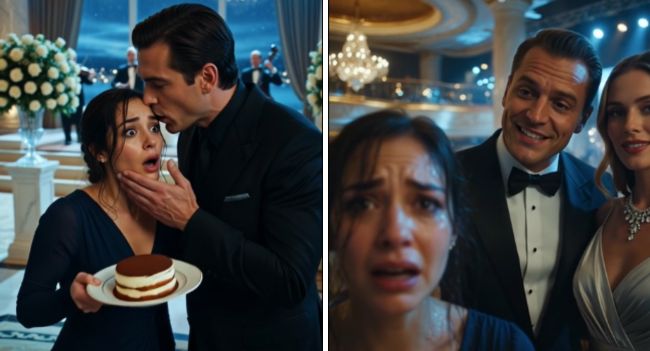
The tiramisu had begun to collapse beneath the ballroom lights.
A dark ribbon of espresso bled into the untouched cream while I stood beside the dessert table, holding the plate as if it gave my hands a reason not to tremble.
Around me, the Lakeview Country Club glittered with old money.
Crystal chandeliers burned above polished marble. A string quartet played near the windows overlooking Lake Michigan. Women in silk and diamonds leaned toward one another beneath arrangements of white roses tall enough to hide secrets. Men laughed with the relaxed confidence of people who had never been asked to explain where their power came from.
I had spent nearly a month’s grocery budget on my dress.
It was navy blue, modest, and three seasons old. The fabric had been altered twice because kindergarten teachers did not buy new gowns simply because a cousin had become engaged to the man who once promised to marry them.
I had almost stayed home.
Then Aunt Rebecca called and said my absence would look bitter.
So I came.
I smiled for photographs. I congratulated Victoria. I accepted champagne I did not drink.
And I prayed Marcus Romano would leave me alone.
He found me before nine.
“Emma.”
His voice still knew exactly where to press.
I turned.
Marcus wore a charcoal tuxedo with a black silk bow tie. His dark hair had been styled away from his face, revealing the clean, handsome features that had once convinced me cruelty was only confidence misunderstood.

Victoria stood on his arm.
My cousin had always been beautiful in a way that required witnesses. Her silver gown poured over her body like liquid light, and the diamond at her throat was large enough to have its own weather.
Marcus looked me up and down.
Not quickly.
He wanted me to feel each second.
“So,” he said loudly, “no wedding yet?”
The conversation nearest us softened.
People did not turn their heads. Wealthy people were more elegant than that.
They simply stopped speaking and listened.
My cheeks warmed.
“I’m focusing on my career.”
Marcus glanced toward a group of his friends.
“Teaching kindergarten?”
A laugh escaped someone’s mouth.
Another person covered a smile with a champagne glass.
Victoria touched Marcus’s sleeve with two manicured fingers. “Don’t tease her.”
Her voice was sweet.
Her eyes were not.
Marcus tilted his head. “I’m not teasing. I admire teachers. Someone has to manage finger paint and nap time.”
More laughter.
The plate shook in my hand.
Six years earlier, Marcus had sat beside me on the roof of our college library and said he loved the way I talked about children.
You make small things sound important, Emmy.
He had called me Emmy then.
Only my father and Marcus had ever used that name.
I wondered whether Marcus remembered.
I wondered whether forgetting had been easier for him than surviving had been for me.
“I’m happy,” I said.
The lie came out thin.
Marcus’s smile widened.
“Of course you are.”
Victoria leaned into him, letting her diamond catch the light. “Emma has always enjoyed simple things.”
Simple.
The word landed like a hand against my throat.
My small apartment. My secondhand car. My classroom with its leaking radiator and construction-paper stars. My father’s unpaid hospital bills stacked inside a kitchen drawer.
Marcus knew all of it.
He had once known where I kept my spare key and how I took my coffee. He had known that I cried when children were frightened and that I hated driving in heavy rain because my mother had died on a wet road when I was twelve.
He knew enough to destroy me gently.
And because he had once loved me, everyone assumed he had earned the right.
“I always thought you’d be married by now,” Marcus continued. “You were so domestic.”
My fingers tightened around the plate.
There it was.
The old accusation.
Domestic when I packed his lunches during finals.
Clingy when I called after his father had surgery.
Unambitious when I chose teaching over the marketing job Marcus’s family offered me.
Too sensitive when he disappeared for entire weekends.
Difficult when I found Victoria’s earrings beneath his bed.
I had loved him for three years.
He had spent the final one teaching me to apologize for noticing what he was doing.
“I suppose life surprises us,” I said.
“Sometimes,” Victoria replied, “people simply end up where they belong.”
She smiled.
Marcus did too.
That was the worst part.
Not the words.
The ease.
They had rehearsed this kind of cruelty in private until it felt natural in public.
A waiter passed behind me. Somewhere near the bar, a glass chimed against marble.
I thought of my father’s last morning.
He had stood in my apartment doorway wearing the brown coat I hated because one sleeve was torn.
I’ll fix it, he had promised.
He always promised to fix things.
Six hours later, the police called to say his car had gone through a guardrail on Lower Wacker Drive.
No witnesses.
No other vehicle.
Just rain, twisted metal, and my father’s watch stopped at 4:17.
I had buried him with the coat still torn.
Marcus lifted his glass.
“To simple lives.”
His friends smiled.
Something inside me cracked—not loudly, not dramatically, but with the quiet finality of ice breaking far beneath a frozen lake.
Then a man’s voice crossed the ballroom.
“There you are, amore mio.”
The quartet faltered.
One violin continued for half a note before silence swallowed it.
Every face turned toward the entrance.
A man stood beneath the carved archway.
He was tall. Broad-shouldered. Dressed in a black suit so perfectly cut it made every other tuxedo in the room look rented. His dark hair was combed back from a face built from hard lines and controlled expression.
He did not look angry.
Anger would have made him ordinary.
He looked calm.
Two men stood behind him, both in dark suits, both scanning doors, windows, and hands instead of admiring the chandeliers.
The country club’s general manager hurried forward.
The stranger did not acknowledge him.
His eyes found mine.
And stayed there.
People moved aside before he reached them.
Not because he asked.
Because they knew who he was.
I did not.
Not yet.
He crossed the ballroom with the patience of a man who had never needed to rush toward anything.
Marcus’s glass lowered.
Victoria’s fingers tightened around his arm.
The stranger stopped in front of me.
Up close, his eyes were not black as I first thought. They were a deep, stormy gray, with faint lines at the corners that suggested he had once known how to smile and had since become careful about it.
His gaze flicked to my trembling plate.
Then to Marcus.
Then back to me.
He lifted one hand and brushed his fingers along my jaw.
The touch was gentle.
The certainty behind it was not.
“I apologize for being late,” he said. “Business required my attention.”
My breath caught.
His thumb rested just beneath my ear.
I should have stepped back.
I should have demanded an explanation.
Instead, I saw Marcus’s face.
The color had drained from it.
The stranger leaned closer.
His mouth passed near my temple.
“Play along,” he whispered.
Then he kissed me.
It was not hungry.
It was not careless.
It was a measured, public act executed with devastating precision.
His hand settled at the back of my neck. His other arm drew me close enough that the plate between us tilted, sending a soft mound of tiramisu sliding onto the carpet.
No one laughed.
When he pulled away, he did not release me.
Marcus looked as if someone had opened a grave beneath his feet.
“Mr. Valentino,” he whispered.
The name moved through the room without being spoken again.
Dante Valentino.
Even schoolteachers knew it.
He owned the Valentino Grand on Michigan Avenue, several restaurants along the river, a private shipping company, and enough downtown property to make aldermen answer calls at midnight.
There were rumors too.
There were always rumors around men who became rich without asking permission from people born richer.
Dante turned his attention to Marcus.
“You didn’t realize Emma was my wife?”
Wife.
The room shifted around me.
Marcus stared at his hand around my waist.
“I—no. Of course not.”
Victoria recovered first.
“Emma never mentioned being married.”
“Emma values privacy,” Dante said.
I forced my lips into something resembling a smile.
“I don’t even know you,” I whispered without moving my mouth.
His gaze remained on Marcus.
“No,” he murmured. “But your father did.”
My heart stopped.
Dante reached into his inner jacket pocket and withdrew a cream-colored envelope.
The handwriting on the front struck me harder than any blow could have.
Uneven capital letters.
A slight downward tilt.
Blue ink pressed too firmly into paper.
For my Emmy.
The plate slipped from my hands.
Porcelain shattered across the marble.
This time, no one pretended not to stare.
Dante caught my elbow.
“I think,” he said to the room, “my wife needs air.”
He led me through the ballroom.
No one stopped us.
Outside, cold wind tore across the terrace and lifted the loose strands of my hair. Lake Michigan stretched beyond the stone railing, black and endless beneath the February sky.
I spun toward him.
“Who are you?”
“You already know my name.”
“I know rumors. I know hotels. I know that you just kissed me in front of two hundred people and called me your wife.”
“It was the quickest way to make Romano step back.”
“Marcus was embarrassing me, not attacking me.”
Dante’s expression hardened.
“Marcus Romano has never done anything without a reason.”
“He humiliated me because he enjoys it.”
“No.” Dante glanced toward the ballroom doors. “He humiliated you because someone told him I might come.”
The wind seemed to disappear.
“What?”
“He wanted to see whether you could draw me into the open.”
I laughed once, breathlessly. “That makes no sense.”
Dante held out the envelope.
“Read it.”
My hand would not move.
“My father died six months ago.”
“I know.”
“How?”
“Because I was supposed to meet him the night he died.”
The words settled between us.
Heavy.
Impossible.
I took the envelope.
The paper had been sealed with clear tape, exactly as my father sealed birthday cards because he never trusted glue.
Inside was a letter and a small brass key.
Emma,
If Dante Valentino gives you this, then I failed to come home.
I stopped breathing.
The handwriting blurred.
I pressed the page flat against the stone railing.
I have spent most of your life trying to keep my mistakes from becoming your inheritance. I told myself silence was protection. It was also cowardice.
Twenty-two years ago, I began working as an accountant for Romano Construction. I discovered money moving through false companies, city contracts purchased with bribes, and buildings approved despite dangerous materials. When I tried to leave, they reminded me that I had a wife and a little girl.
My knees weakened.
Dante moved closer but did not touch me.
I kept reading.
Your mother’s accident was not an accident.
A sound came from my throat.
Small.
Broken.
The page shook violently.
“She died because the road was wet,” I whispered.
Dante said nothing.
The Romano family believed I had copied their records. Your mother was followed after leaving work. The driver meant to frighten her. He forced her car across the center line.
I slid down against the railing.
The cold stone tore through my dress.
Dante crouched in front of me.
I remembered my mother’s red scarf.
Her hands smelling like oranges.
The police officer kneeling in our living room.
My father vomiting in the kitchen after he thought I had fallen asleep.
All those years, I had believed grief had made him distant.
Now I understood.
Fear had.
“I knew them,” I whispered. “I dated Marcus. I brought him into our home.”
“Your father tried to keep you away from the Romanos without telling you why.”
“He hated Marcus.”
“He was terrified of him.”
I looked back at the letter.
Dante’s father died in a warehouse fire caused by the same company. Dante has spent years building enough power to expose them without being buried beside the evidence. I gave him copies of everything I found.
The originals are hidden where only you would think to look.
The brass key pressed into my palm.
I read the final lines.
Do not trust pity. Do not trust family simply because they share your blood. Trust the man who comes when he has the most to lose.
And forgive me, Emmy.
I loved you enough to be afraid every day.
Dad
For several seconds, the world contained nothing but wind and paper.
Then the ballroom doors opened.
Marcus stepped onto the terrace.
Victoria followed him.
So did Uncle Raymond, Marcus’s father.
Raymond Romano was silver-haired, elegant, and smiling.
He had attended my father’s funeral.
He had stood beside the grave and squeezed my shoulder.
Your father was a good man, he had said.
Too good for this world.
Now he looked at the letter in my hands.
His smile vanished.
“Emma,” he said carefully, “whatever Valentino has told you—”
“My mother.”
Raymond stopped.
I stood.
“My mother did not lose control of her car.”
Marcus looked at his father.
“Dad?”
Raymond ignored him.
“Your father was unstable after her death. He blamed people because blame was easier than grief.”
Dante rose beside me.
“You should choose your next sentence very carefully.”
Raymond’s eyes narrowed. “This is a family matter.”
“No,” I said. “It stopped being a family matter when you buried my mother.”
Victoria stepped away from Marcus.
Only half a step.
But he noticed.
“Emma,” Marcus said, “I didn’t know anything about this.”
I looked at him.
For years, I had dreamed of seeing regret on his face.
Now that it was there, it gave me nothing.
“You brought me here tonight.”
“Victoria invited you.”
Victoria’s face changed.
Barely.
But enough.
I turned toward her.
She lowered her eyes.
“Why?” I asked.
Her mouth trembled. “Marcus said Dante might contact you. He said we only needed to make you upset.”
Marcus seized her wrist. “Stop talking.”
Dante’s men appeared in the doorway.
Marcus released her.
Victoria rubbed the pale imprint his fingers left behind.
“I thought it was business,” she whispered. “I thought they wanted to see whether Valentino was protecting you.”
“Why would they care?”
Her gaze shifted toward Raymond.
“Because your father mailed something before he died.”
Raymond moved fast.
Not toward me.
Toward the letter.
Dante stepped between us.
The older man froze.
Dante’s voice dropped.
“The key, Emma.”
I looked at the brass key in my palm.
The originals are hidden where only you would think to look.
Not at my father’s apartment.
Not in a bank.
Not anywhere a frightened accountant would search.
Somewhere only I would think to look.
A memory opened.
My classroom.
The reading corner.
My father had built the wooden bookcase himself. He had insisted on repairing it after one of the lower panels loosened.
You never know what little things might need protecting, Emmy.
The evidence was inside my kindergarten classroom.
I looked at Dante.
He saw the answer before I spoke.
We left through the service entrance.
Snow had begun to fall.
Dante’s car moved through Chicago with two black vehicles behind us. I sat in the rear seat clutching my father’s letter while the city smeared past in gold and white.
“Why did you call me your wife?” I asked.
Dante watched the road.
“People hesitate before harming what they believe belongs to a dangerous man.”
“I don’t belong to you.”
“No.”
His answer came immediately.
Something in my chest loosened.
“You could have said I was your fiancée.”
“Romano would have assumed it was temporary.”
Despite everything, a broken laugh escaped me.
Dante looked at me then.
For one second, the feared man in Chicago seemed almost human.
“My father trusted you,” I said.
“He saved my life.”
“How?”
“He found me in the warehouse after the fire. I was seventeen. My father was already dead.” Dante’s jaw tightened. “Your father carried me out before the roof collapsed.”
The car fell silent.
“He never told me.”
“He made me promise not to come near you unless the Romanos discovered the evidence.”
“And tonight?”
“Your cousin used your name on the guest list. Raymond’s men leaked it to people they knew would inform me.”
“So everyone was playing a game except me.”
Dante looked down at my father’s letter.
“Yes.”
The honesty hurt more than reassurance would have.
At the school, the hallways smelled of waxed floors, crayons, and the faint sour sweetness of spilled milk.
My classroom looked impossibly small beneath the emergency lights.
Paper snowflakes hung from the ceiling.
Twenty-three painted handprints covered the back wall.
Dante stood among the tiny desks like a shadow that had entered the wrong dream.
I knelt beside the reading corner.
The brass key fit a narrow lock hidden behind the lowest shelf.
Inside was a metal box.
My hands shook as I opened it.
Ledgers.
Photographs.
Copies of permits.
A flash drive.
And beneath them, a phone.
My father’s old phone.
The screen lit when I pressed the side button.
One video file waited.
Dad sat at our kitchen table wearing the torn brown coat.
He looked tired.
Older than I remembered.
“Hi, Emmy.”
My hand flew to my mouth.
Dante turned away, giving me privacy he could not truly give.
“If you’re watching this, I’m sorry. I wanted to tell you everything after I met Dante. I wanted us to leave Chicago together.”
Dad looked down.
“There’s one more thing you deserve to know.”
My chest tightened.
“Dante believes the Romanos killed his father because of the warehouse records. He’s wrong.”
Dante turned.
The room went still.
“My signature approved the materials.”
Dante stepped toward the phone.
Dad continued.
“I knew they were unsafe. Raymond threatened Emma and her mother. I signed anyway.”
The pain on Dante’s face did not look like anger.
It looked like a building collapsing inward.
“I caused the fire that killed Dante’s father.”
I stared at him.
He stared at my father.
Happy relief had filled me only moments before. Proof. Justice. A final act of love.
Now the truth tore through it.
My father had not merely witnessed evil.
He had helped it happen.
Dad’s voice broke.
“Dante, if you are there, I have no right to ask forgiveness. I saved you from that fire because I could not save your father. Every document I collected afterward was not courage. It was penance.”
Dante closed his eyes.
“I planned to confess after I gave the evidence to federal investigators. Raymond discovered the meeting. If I die before then, do not let Emma carry my guilt.”
The video ended.
Snow tapped softly against the classroom windows.
I waited for Dante to speak.
He did not.
“I’m sorry,” I whispered.
His eyes opened.
“You didn’t sign those papers.”
“He was my father.”
“And he was the man who pulled me out.”
“He helped kill yours.”
“Yes.”
The word cut cleanly.
I began to cry.
Not prettily.
Not silently.
I folded over beside the bookcase while grief split into shapes I could no longer name. I mourned my mother, my father, the person I thought he was, and the terrified man he had actually been.
Dante knelt in front of me.
For a moment, I thought he might leave.
Instead, he took the letter from my crushed hand and folded it carefully.
“My father died because frightened men obeyed cruel ones,” he said. “Yours spent twenty-two years trying to undo one cowardly choice.”
“That doesn’t make it right.”
“No.”
“Then how can you stand here?”
His gaze moved across my classroom—the paper stars, the tiny chairs, the books worn soft by children’s hands.
“Because he asked me to protect you.”
“Is that all?”
Dante was silent long enough to make the answer matter.
“No.”
He touched my face with the same hand that had held me in the ballroom, but now there was no audience and no performance.
“I saw you once before.”
“When?”
“Your father brought me here after school last spring. You were reading to a boy whose mother had been arrested. He would not stop crying, so you sat on the floor with him for two hours.”
I remembered that day.
A man had stood outside the classroom window.
I had assumed he was someone’s driver.
“I asked your father how someone like him raised someone like you,” Dante said.
My tears fell harder.
“What did he say?”
Dante’s mouth curved with unbearable sadness.
“He said you were the proof that one terrible choice did not have to become a bloodline.”
Sirens approached in the distance.
Dante’s men had already delivered copies of the evidence to federal agents. By dawn, Raymond Romano was arrested at his estate. Investigators took Marcus from the country club before the engagement party ended.
Victoria gave a statement.
She returned the ring.
Months later, the newspapers called it the largest municipal corruption case Chicago had seen in decades.
They printed photographs of Dante entering court.
They printed photographs of Marcus in handcuffs.
They printed my father’s name too.
Some called him a whistleblower.
Others called him an accomplice.
Both were true.
I returned to my classroom.
Children still needed their coats zipped. Paint still spilled. Small hearts still broke over missing crayons and absent parents.
Dante did not pretend to be my husband again.
He came slowly.
Honestly.
Coffee after school. Walks beside the lake. Long silences in which neither of us demanded that the other forgive the dead.
A year later, he stood with me at my father’s grave.
The brown coat was still buried beneath us.
“I hated him for a long time,” Dante said.
“I know.”
“I loved him too.”
“I know that too.”
He slipped his hand into mine.
No claim.
No performance.
Just warmth.
On the anniversary of the night we met, Dante took me back to the country club.
The ballroom had been emptied for renovations. No chandeliers. No champagne. No smiling witnesses.
Only dust, moonlight, and the faint marks where the dessert table had once stood.
He stopped there.
Then he held out a small ring.
Nothing enormous.
Nothing designed to blind a room.
A simple band with a tiny diamond set low against the gold.
“This time,” he said, “I would like to ask before I call you my wife.”
I looked at the man my father had saved, the man my father had wronged, and the man who had carried both truths without using either one to punish me.
“Yes,” I whispered.
Dante slid the ring onto my finger.
Outside, snow began to fall over Chicago, covering the roads where our parents had died, the buildings their choices had scarred, and the city that had once taught us that fear was the same thing as fate.