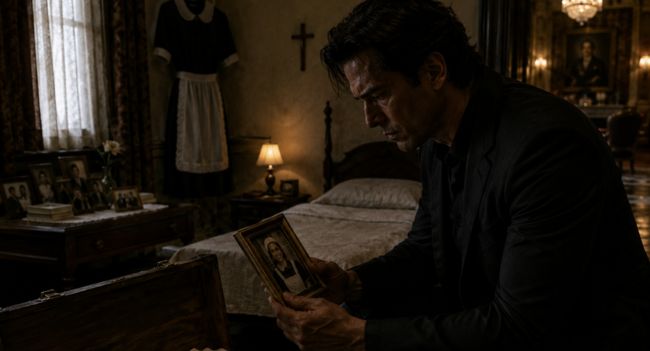
In Ronan Gallagher’s world, people disappeared for only two reasons. They betrayed him, or they feared him.
Tessa Callaway was neither. That was what kept Boston’s most powerful man awake long after the house had gone quiet.
For four years, the shy maid had barely held his gaze longer than three seconds. She moved through his mansion like something meant not to be noticed, and every single night, without being asked, she left one small lamp burning at the end of the hallway, waiting for him to come home. He had never once thanked her. Never once asked why.
He came in at two o’clock that Thursday morning to a hallway drowned in darkness.
For the first time in four years, the light wasn’t on.
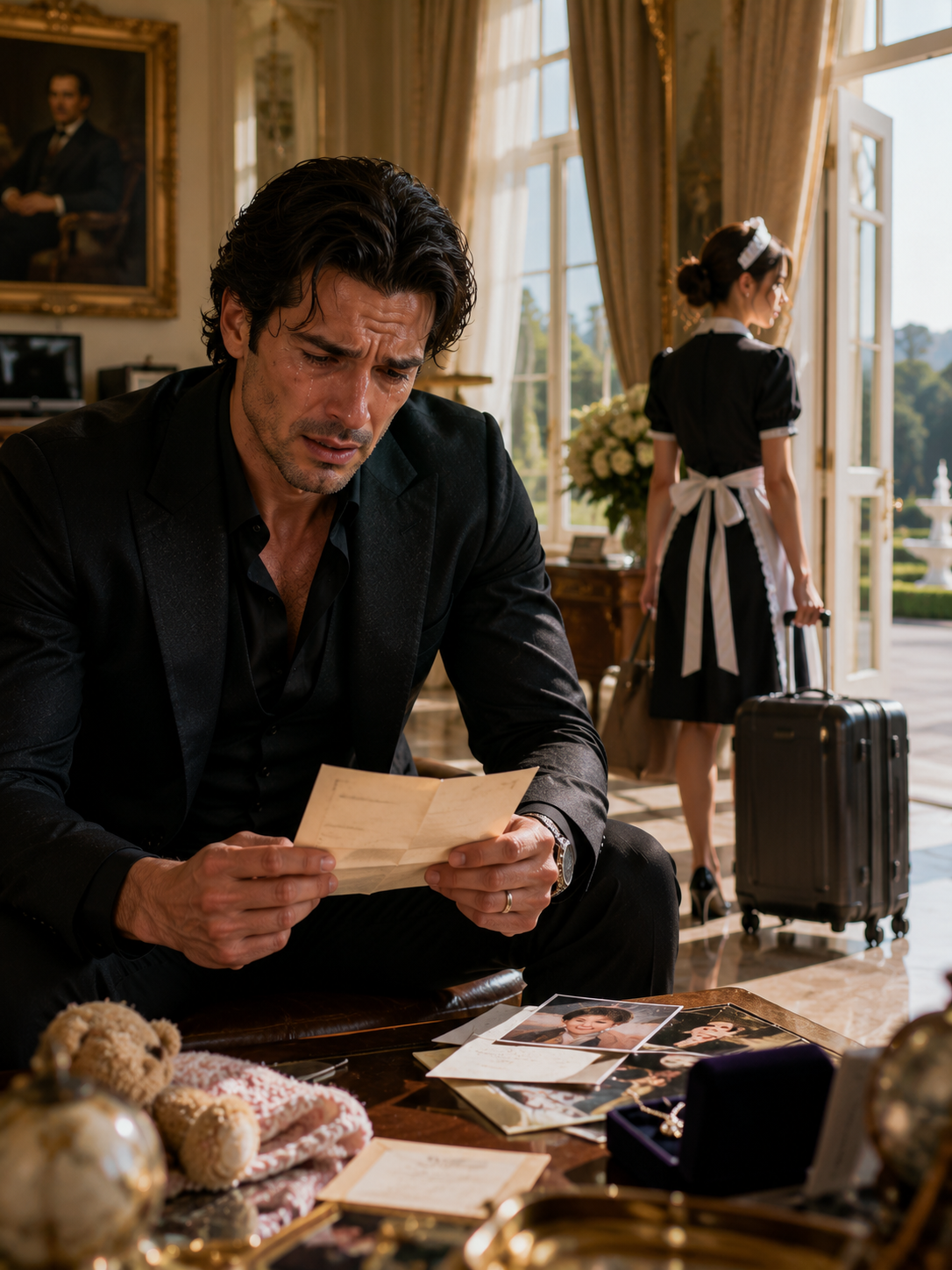
He didn’t think much of it. He told himself the bulb had burned out.
The next morning told him otherwise. The kitchen was spotless, her apron hung on its hook as though she meant to return after lunch, and on the table sat one white envelope, his name written across it in careful, timid script.
*I resign. Thank you for giving me a quiet place.*
*— Tessa Callaway*
No reason. No goodbye.
“Call the agency,” he told Brendan Walsh, his head of security, without looking up from the letter. “Find a replacement before the weekend.”
To him, it was no different from replacing a burned-out bulb.
Brendan lingered a second longer than usual, as though he meant to say something. In the end, he only nodded.
The first replacement arrived Monday. Fifteen years of experience on Beacon Hill, a file three times thicker than Tessa’s had ever been. That evening she set down a bowl of potato soup. Ronan tasted one spoonful and pushed it away.
“Too salty.”
It wasn’t inedible. It was simply saltier than a taste he’d never once thought to name — the taste that had simply appeared on his table every night for four years.
The second arrived Tuesday. Quick, efficient, tireless. She rearranged his entire wardrobe by color before lunch. That evening he opened the closet for the gray shirt he wore to harbor meetings and stood there for nearly a minute. It wasn’t where his hand had reached for it without looking for four straight years. It was three shelves over, filed correctly by shade, perfectly wrong.
He said nothing to her. He only understood, with something close to fury, that a shirt had made him angry, and he couldn’t say why.
The third arrived Wednesday, the agency’s most “thoughtful” candidate. That night he came home at one in the morning to a house blazing like a hotel — every hallway light on, every lamp in a reading room he hadn’t entered in months glowing white against the driveway gravel.
He sat in the car and stared at his own house, and it had never looked less like home.
For four years it had welcomed him with one small lamp and nothing else — enough light to find the stairs, dim enough to tell him the house was asleep and expected nothing from him except that he arrive safely. He had never thought that lamp was worth thinking about.
Now the whole mansion gasped through twenty bulbs at once, and he would have rather walked into the dark.
The next morning he told Brendan to let all three go. Brendan asked only one question — how did Ronan intend to eat while they waited for someone new — and got no answer, because Ronan didn’t have one either.
That Wednesday night, working past midnight over shipping paperwork, a familiar dull ache climbed the back of his neck. He reached for his blood pressure medication in the corner of the desk where it always stood beside a glass of water.
The bottle was empty.
For four years, it had never once run dry. Whenever the pills ran low, a new bottle simply appeared, quiet and regular as breathing, and he had filed the fact away under *automatic*, under *someone handles it*, and never asked who.
He found an old delivery slip buried in the drawer. A pharmacy on Hanover Street he’d never heard of. Despite the hour, he called the number. An old man answered, and when Ronan asked why the delivery hadn’t come this month, there was a pause — then honest surprise.
“Is Miss Callaway no longer calling us?”
Ronan’s grip tightened on the receiver.
The man explained, still unguarded, still sincere — that for four years, about a week before the bottle emptied, a young woman had called to read them the prescription number, ask about the expiration date, and remind them again and again the medicine had to arrive before three in the afternoon, because her employer needed it waiting on his desk that evening. Once, during a snowstorm, when the delivery trucks couldn’t run, she’d taken the train herself to collect it.
“We always assumed she was family,” the man said.
Ronan thanked him and hung up, and sat a long time with nothing but the clock’s ticking for company.
He was a man who anticipated every move his enemies might make, who knew every clause of every contract, every face that had ever crossed his family’s path. And he hadn’t known the name of the pharmacy that had kept his heart beating steadily for four years.
He looked at the empty bottle, and a colder question rose beneath the pain in his neck.
If that bottle had never filled itself — how many other parts of his life had quietly been kept running for four years by a pair of hands he’d never once thought to look for?
The question followed him through a sleepless night, and the next morning, instead of the study, Ronan walked toward the rear wing — the servants’ quarters, a part of the house he hadn’t set foot in once in four years.
The corridor there was narrower, the silence different. At the far door, unlocked, he stepped into the room where that woman had lived beneath his roof for four years.
It took one glance to see all of it. A narrow bed, sheets smoothed without a wrinkle, blanket folded into a square like a barracks cot. A wardrobe. A small table. One chair.
On the table, a worn leather Bible, its pages rounded from years of turning. No name on the flyleaf. Only pencil lines beneath certain verses, thin and careful.
On the windowsill, a small pot of lavender, soil still damp. Beneath it, a folded note in the same timid handwriting he’d seen on the envelope.
*Water on Monday morning. Don’t let the afternoon sun fall directly on it.*
She had left in such a hurry she couldn’t take the plant — and still slowed down long enough to leave instructions for someone she’d never meet.
He opened the wardrobe. A few uniforms, all long-sleeved. No dresses, no shoes for going out, nothing that spoke of a woman of twenty-seven. Every drawer he opened was empty. No photograph. No letter. No forgotten receipt. A room lived in for four years, and cleared like a hotel suite prepared for the next guest.
He had Brendan bring him her personnel file. It came back thinner than he expected — a handwritten application from four years ago, every line filled in precise handwriting except one, left blank: *Emergency contact.* And a single yearly review, signed by the housekeeper, repeating the same three words. *Hardworking. Dependable. Never complains.*
No one on staff knew where she’d come from. No family mentioned, no letters received, no visitors in four years. Not one day of leave. Not Christmas. Not Thanksgiving.
He remembered the interview now — an autumn afternoon, a thin young woman standing at the edge of the rug as though afraid to soil it. He’d been on a call. When he hung up, he’d asked her exactly one question.
*Do you know how to keep quiet?*
She’d lifted tired eyes to his for three seconds, then nodded, and he’d waved the housekeeper in to handle the rest.
That had been everything. He had hired the woman who would run the rhythm of his entire life with a question that now, in hindsight, sounded less like an interview and more like a warning — and she had answered it more completely than he ever imagined.
He called Mrs. Dorothy into the study, the only member of the staff who still looked him directly in the eye, and asked her plainly what she knew.
She studied him a moment, as if she’d been waiting years for this conversation.
“Do you want to hear what she did, or who she was?”
“Everything.”
—
## Chapter 2
Mrs. Dorothy folded her hands and began, unwinding the story like thread from a spool. How Tessa personally inspected every food delivery each week, because the young master was allergic to shellfish, and one supplier’s oil had once carried shrimp extract the label never mentioned — she’d quietly switched suppliers and told no one but the housekeeper.
How, when his father’s old leather watch strap broke and sat forgotten on a desk for three days, Tessa hadn’t dared send it out to a stranger’s hands. She’d bought leather and thread herself and stayed up two nights repairing it, then unpicked her own first attempt because it wasn’t even enough. *The belongings of the dead should be cared for by hands that still love them*, she’d told Mrs. Dorothy.
Ronan looked down at his father’s watch on his own wrist — at the tiny, perfectly straight stitches he’d spent a year believing were a craftsman’s work.
Mrs. Dorothy went on. The shoes polished every Sunday. The marmalade from a shop seven streetcar stops away, bought on her own days off. The bedroom warmed two hours before his return from any long trip, because she’d once noticed he coughed for a week after a night flight.
Then her voice slowed.
“The hallway lamp,” she said. “You probably never asked why it was lit every night.”
A few months after Tessa started, one night she’d fallen asleep too exhausted to switch it on. Around three, she woke to the sound of a man striking furniture in the dark, then heavy footsteps on the stairs. The next morning she found a cabinet shifted, a scratch in the wood. She said nothing to anyone, but came to Mrs. Dorothy with red eyes, blaming herself for a week.
“He works himself into the ground and comes home, and I couldn’t even leave him a little light,” she’d said.
Mrs. Dorothy told her no one blamed her — that he didn’t even know.
Tessa had shaken her head. *It’s precisely because he doesn’t know that someone needs to remember for him.*
From that night, for four years, the lamp never went dark before he came home. Even the nights she ran a fever, she went down first, turned it on, and only then let herself lie down.
The study stayed silent a long time after Mrs. Dorothy finished. Ronan sat behind his desk, eyes fixed on nothing, understanding for the first time that he had paid a woman a monthly wage to clean his house — and she had quietly taken responsibility for every part of his life he had neglected. His health. His father’s memory. His sleep. Even twelve steps of hallway.
“Why do you think she quit?” he finally asked.
Mrs. Dorothy rose, smoothing her apron, looking at him with the eyes of someone who knew the difference between running away and sacrifice.
“Young master. That girl didn’t quit. Someone like her only leaves when she has no other choice.”
—
## Chapter 3
That evening, Brendan knocked with something in his hand — an old hardbound notebook found beneath folded kitchen towels, corners curled soft from handling.
“I read a few pages,” he said quietly, setting it down. “You should read the rest yourself.”
The first half was ordinary — a household ledger, every column of grocery money added and subtracted to the last cent, small notes in her careful slant. *Tomatoes cheaper at week’s end. Eggs from the farmers’ market fresher than the store. Don’t buy too much rosemary, the master doesn’t eat it.*
He turned it over. From the back cover, a second notebook began — and every page of it was about one person.
*Tuesday, he has a late meeting. Warm the soup at one and leave it outside the study. Don’t knock — he doesn’t like anyone seeing him tired.*
*He doesn’t sleep well in November. That’s the month his father died. Don’t vacuum the second floor in the morning, let him keep whatever sleep he can.*
*Before every harbor meeting he wears the gray shirt. Press it the night before — those mornings he leaves earlier than usual.*
*When he comes home and goes straight upstairs without eating, something’s gone wrong at the harbor. Don’t clear the food too soon — around midnight he’ll come looking. Leave bread, keep the soup warm.*
*He drinks his coffee black, but sometimes takes a peppermint from the wooden box in the reading room. It’s almost empty — buy more, the green wrapper, not the white.*
Ronan sat straighter with every page. Every line was a small mirror angled at himself from somewhere he’d never once stood to look.
*Anniversary of his father’s death — he’ll say nothing needs preparing. There should still be white flowers in the drawing room. He stops and looks at them every year, though he never says anything.*
*When he paces the study on the phone and his footsteps sound heavy, don’t ask him anything that night. Just leave ginger tea on the windowsill. His hands go cold in winter but he’ll never wear gloves. I bought a pair and left them in the car — tell the driver they were a gift from the company. Don’t say my name.*
He remembered those gloves. Two winters ago. He’d worn them all season, certain they were some polite courtesy from a business partner.
These weren’t the notes of someone trying to keep a job — those notes track mistakes and rewards. Every line here was about the moments he’d been weakest, and most alone, moments he’d spent his whole life hiding from his men, his enemies, himself. She had seen every one of them, and quietly laid a thin layer of protection over each — a bowl of soup, a cup of tea, a silent mourning, an anonymous pair of gloves.
She hadn’t served him. She had sheltered him from wounds hidden from the entire world, with a devotion so steady it had become invisible.
Near the binding, a small piece of paper slipped free and spun onto the desk. A receipt, edges yellowed, fold lines worn soft from opening and closing.
*Purple asters, delivered monthly, third of each month. St. Augustine Cemetery, Eastern Section. Grave of Mrs. Margaret Gallagher.*
His mother.
*Payment: cash. Regular customer, Miss Tessa. Paid three months in advance.*
For three years, whenever he visited his mother’s grave on the anniversary, fresh flowers had waited in the stone vase. He’d assumed the cemetery’s grounds service included it, the way it included cutting the grass.
There had been no service. Only a maid, taking money from her own wages every month, to send flowers to a woman she’d never met — the mother of a man who’d never spoken more than ten sentences to her in a single day.
He drove to the cemetery that night without calling anyone. The old groundskeeper was locking the shed as he arrived. In the stone vase at his mother’s grave, a bouquet of purple asters was wilting, petals darkened but every stem still arranged with care.
The date told him — the previous month’s delivery. Her last one, before she disappeared. This month, for the first time in three years, there were no fresh flowers.
The groundskeeper, seeing the Gallagher name on the stone, said quietly that a young woman came every month, arranged each stem herself, and stayed a while before leaving. Once, in a terrible downpour, he’d told her to take shelter. She’d only knelt and cleaned the headstone with a cloth she’d brought, and didn’t leave until she’d finished — soaked through.
Ronan stood before his mother’s grave for the first time in years on a day that wasn’t her anniversary, and understood that the stone’s clean face wasn’t luck. It was clean the way stone only stays clean when someone wipes it by hand, again and again, without ever being asked.
He no longer wondered why she’d left. That question had been swallowed by a larger one.
*Who was she, really?*
—
## Chapter 4
Three days later, Brendan returned with a file so thin it hurt to look at — as if twenty-seven years of a life could fit inside twenty pages.
“We searched carefully, sir,” Brendan said. “It’s thin because this is genuinely all there is on paper.”
Tessa Callaway, born in Worcester, eldest daughter of a plumber and an elementary school teacher. Excellent grades, a gift for sewing, first prize in a citywide crafts competition, a partial scholarship to a fashion college in Boston she never once attended.
The next page was a fire department report, eight years old. A short in old wiring, before dawn, a two-story wooden house. Both parents dead. Their nineteen-year-old daughter escaped with burns on her left arm — three weeks in the hospital.
Ronan sat with that line a long time. Her left arm. He remembered the wardrobe — every uniform long-sleeved, even through the worst of a Boston summer, when every window in the house stood open. He’d never once wondered why.
A younger brother, Sam Callaway, three years behind her, born with a congenital heart defect. Spared the fire by a scheduled treatment that kept him elsewhere that night — leaving his nineteen-year-old sister as the only family he had left in the world.
The years after read like dry government forms, and the dryness made them heavier than any careful prose could have. Three jobs at once for three straight years — a diner, a laundromat, alterations sewn at night. Sam’s hospital file thickening year over year, treatments growing costlier than three low-wage jobs could ever carry.
A pawn shop receipt stopped him cold. A gold wedding ring, sold outright. The shop owner’s note: *Customer said it was her mother’s. Stood at the counter a long time before handing it over.*
She’d carried that ring through the fire and the hardest years after, only to trade it, in the end, for another round of her brother’s hospital bills.
He thought of the household notebook, its careful accounting of every last cent spent on vegetables, and understood her frugality hadn’t been a habit. It was a scar — the boundary, for years, between hope and despair.
Near the end, one brief line. Sam Callaway, dead at twenty, heart stopped in his sleep. No will, no property — only confirmation his sister had paid every funeral expense, attended by a handful of people: neighbors, two cardiac nurses, a priest.
Ronan set the funeral date beside the date on her job application.
She had knocked on the Gallagher door, stood at the edge of the rug in this very study, and nodded to the only question he’d asked her, exactly one week after burying the last person she had in the world.
One week. He had asked a woman who’d just lost everything whether she knew how to stay silent, and she’d nodded, because for her the entire world had already gone silent. There was no one left to tell anything to.
Ronan sat back, a cold hand seeming to rest against his neck. Brendan hadn’t left — as if there was more, still, that he hadn’t said.
He turned to the final page — a bank statement — and instead of handing it over as he had the rest, he lowered it slowly, the way a man sets down something that might explode.
Ronan picked it up. At first it read as ordinary — sparse, modest, the transactions of someone who lived frugally, wages deposited, small amounts withdrawn, the rest left untouched as if she didn’t dare spend it on herself.
Then a line stopped the room cold.
A transfer of fifty thousand dollars, three months before she disappeared. Sender: a maritime trading company registered in the North End.
Ronan knew that name. He’d seen it in files on his rivals, years of reports his men had gathered on every foot of dockland ever contested. A shell company of the Rors — the Gallagher family’s oldest enemies.
Fifty thousand dollars. Sitting in the account of the shy maid who’d never once held his gaze longer than three seconds.
He read it a second time. A third. As if reading it again might change it.
It didn’t.
And slowly, mercilessly, everything he knew rearranged itself into the order a lifetime in the underworld had taught him to see first, before anything else. A person who knew when he slept, what medicine he took, which shirt he wore before harbor meetings, which month left him weakest. A person who had moved freely through his home for four years, touching his food, his medicine, his sleep — unchecked, unsuspected, because she was quiet, because she was invisible.
If the Rors had wanted a blade against the heart of the Gallagher family, what position could possibly have been more perfect?
Ronan rose so fast the whiskey glass on his desk shattered against the wall. Brendan didn’t move to sweep it up. He only watched the man breathing hard beside the desk.
“Stop every search,” Ronan said, voice ground flat as steel on stone. “Bring the men back. Lock the room in the rear wing. No one speaks her name in this house again.”
—
## Chapter 5
For ten days, the mansion sank into a silence heavier than the week she’d disappeared. No one spoke the forbidden name. The lavender withered, unwatered, behind a locked door.
Ronan buried himself in shipments and contracts, trying to rebuild the wall of steel he’d lived behind for seven years. But every night, at the gates, some part of him still faltered a single beat before the darkness — and he hated himself for it.
On the tenth day exactly, a gatekeeper announced a visitor: an elderly attorney named Howard Pierce, carrying an envelope under conditions so strict it couldn’t be mailed, couldn’t reach anyone but Ronan, and only on the tenth day — not one earlier, not one later.
“Her instructions were precise,” Pierce said. “If it arrived too soon, she said, someone would die. If too late, it might already be too late.”
He knew nothing more, and Ronan asked nothing more.
Alone, he broke the seal. Her handwriting again — the same on the envelope, the lavender note. No greeting. She wrote as if she already knew exactly what he’d be feeling.
*If you’re reading this, you’ve probably seen the bank statement. You probably believe I belong to the Rors. I don’t blame you. That’s exactly what they want you to believe — and I had to let them, because your life matters more than my honor.*
She wrote of an early morning, three months before she left, when she found the study door open and Eddie Corrigan — his father’s man for fifteen years, his own second-in-command for seven — standing at the desk with the drawer open, photographing pages of the private calendar. Not the shared schedule every secretary already had. The private one. Grave visits. Meetings no one else was meant to know about.
*I clean that desk every day. I know every senior man already has your official calendar. A person only photographs the private one when he needs to know which roads you travel without your guards — because he intends to do something those guards are meant to stop.*
She hadn’t dared go to Ronan directly. Who was she — a servant, accusing a man fifteen years at his side, with no proof? So she’d reported it, quietly, to Frank Doyle, head of estate security. The safest channel, she’d believed.
*That was the greatest mistake of my life. Only later did I understand — Mr. Doyle belongs to Mr. Corrigan.*
Two days later, the money appeared in her account. Corrigan found her in the garden shed that same afternoon, and spoke to her gently, as if discussing the weather.
*Young lady, in the eyes of the world you’re now someone who took Ror money. It’s in black ink on white paper. Say one word, and I’ll be the first to show him. Whom do you think he’ll believe — an orphan with no one to defend her, or the man who stood beside his father for fifteen years?*
She wrote what came next slowly, the letters trembling across the page.
*If I spoke, I’d die without saving you. If I stayed silent, sooner or later they’d deal with a witness anyway. Worst of all — the longer I stayed close to you, the more reason the knife at your back had to strike sooner. So I made the only move left to me. I withdrew cash, hastily, clumsily — exactly like a frightened girl running off with dirty money. I wanted Corrigan to see a pawn who’d taken herself off the board. No one hunts down a coward who’s already silenced herself.*
*As for my honor — I had to leave it behind in that house, because if I’d explained before leaving, you’d have kept me there. You’re that kind of man. And if you’d kept me, everything I’d done would have meant nothing.*
The final lines were slower, more careful, as if written last, after every tear had dried.
*They’ll move on the anniversary of your father’s death — the one day you leave the mansion without your protected route. I know that calendar well enough to know it, and they photographed it clearly enough to know it too. Check the March shipping ledger, Pier 9. Everything you need is there. Don’t look for me. And if you reach this line and still believe me — ask Mrs. Dorothy about the hallway lamp.*
Ronan sat with the letter until the room went dark around him. When he finally summoned Brendan and handed it over, the two men looked at each other in silence, doing the same arithmetic.
Fourteen days remained until the anniversary. Fourteen days to overturn a board the enemy had been arranging for three months.
“Unlock the rear wing. Water the plant,” Ronan said, calm in a way that felt almost unnatural. “And from tonight, everything we do stays between the two of us. No secretaries, no switchboard, no third man — not even the ones you trust most. We just learned the safest channel can still be a funnel straight into the enemy’s ear.”
—
## Chapter 6
The investigation moved quiet as a needle through cloth. Brendan pulled the March shipping ledger under cover of a routine audit and the two men spent a night beneath the desk lamp watching the numbers tell their own story — loading fees paid to a company no warehouse had ever recorded, uneven figures rounded to look ordinary, all of it flowing to the maritime company in the North End. Every authorization carried the same familiar, confident blue ink: Eddie Corrigan’s signature.
Surveillance on Frank Doyle turned up a diner in the North End, a table with two men whose faces matched files already open on the Rors.
Every piece fell into place with a smoothness that felt almost engineered. The man inside the house who photographed the schedule. The man at the door who passed it along. The money threading through the very harbor they meant to claim.
Then, in the family archive vault, Brendan laid two documents side by side under the lamp — the falsified March ledger, and a yellowed seven-year-old payment record pulled from Ronan’s father’s old safe. Same company under an earlier name. Same account, digit for digit. Same rounded amounts. Same confident blue ink.
The date on the older document fell within the week his father’s car had been ambushed on a road that appeared on no official schedule — a road only five people alive had known his father took.
For seven years, the family had believed a driver had sold that route to the Rors. Three men had been dismissed. One had vanished from the city. The case had closed on a hatred that never found its true answer.
It had never been the drivers. Eddie Corrigan — who’d wept at the funeral until his eyes went red, who’d delivered the eulogy in a broken voice that bowed the whole church — had sold that road himself, and built his own rise on the very death he’d arranged.
Ronan spent that night alone with his father’s old pistol on the desk before him, understanding exactly what his world expected of him now. Quick. Clean. No police, ever. No one would condemn it — they’d call it a righteous sentence.
But it wasn’t Eddie’s face that stayed in his mind. It was a line of timid, slanting handwriting. *Your life matters more than my honor.* A woman who had sacrificed her home, her work, her clean name, so he wouldn’t die on an empty road the way his father had.
If he pulled the trigger, he’d win in his father’s way — and one day, some other Eddie would stand weeping beside his own grave. If instead he followed the evidence to men in gray suits, then for the first time in three generations, a blood debt would be collected without creating another.
At dawn, he locked the pistol away and told Brendan: prepare the car. They were going to see Eddie, unarmed.
At the Pier 9 warehouse, under a single hanging bulb, Ronan laid the evidence on the table one piece at a time — the ledger, the calendar photograph, the bank statement — and finally the yellowed seven-year-old record.
Eddie’s face ran through a lifetime of performance — shock, wounded innocence, a bargain, a plea about debts and threats — and then, at the last document, his knees hit the concrete.
“My father owes you a bullet,” Ronan said, each word falling like stone. “I sat with his gun for a whole night, thinking about how to pay it. But someone left my house carrying a crime she didn’t commit, so I wouldn’t die on a road the way he did — and so I wouldn’t spend my life becoming someone like you.”
He gave Eddie one night. A police station by morning, before Ronan stood at his father’s grave, or whatever waited at the end of any other road he chose.
Corrigan chose flight. He was stopped quietly at the city limits before dawn, no siren, no resistance. That same night, federal agents lit up addresses across the North End tied to the Rors.
On the anniversary of his father’s death, Ronan drove to St. Augustine Cemetery on no protected route, because for the first time in seven years, no one was waiting anywhere to kill him. At his mother’s grave, he placed a bouquet of purple asters — the first flowers he’d ever chosen and paid for himself, from a little shop on Tremont Street a young woman had quietly visited for three years.
—
## Chapter 7
In the weeks after, Boston read in the papers that a money-laundering network around the harbor had been dismantled. Underworld men whispered about something stranger — that the Gallagher family had known, and hadn’t lifted a hand to settle it the old way. No blood. No back-alley reckoning. For the first time in seven years, Ronan passed through his own gates without checking the mirror, ate a meal no one had tasted before him, slept without his phone under his pillow.
Yet the house had never felt emptier. No soup waited outside the study at one in the morning. No one remembered November was coming. The lavender lived again, watered on schedule by staff who knew nothing of the note that had once accompanied it. And every night, the hallway lamp came on precisely on time, controlled now by an automatic timer — perfectly regular, perfectly hollow, because he knew no one stood behind that light remembering him anymore.
One evening, reading her letter for a count he’d long since lost, he summoned Brendan and gave an order. Brendan, who had read every line she’d written, asked the only fair question.
“She asked you not to look for her. Why are we ignoring that?”
Ronan stood at the window a long moment before answering.
“All my life, people have stayed near me out of fear, or for money. My enemies respect what I can take from them. My men follow what I can give them. She was the only person who stayed because of *me*. Because I was a man, not a name or a chair.” He paused. “And I don’t even know her birthday, Brendan. Four years, and she remembered every smallest thing about mine. I’m not searching to protect myself anymore. Every danger’s gone. I’m searching because there are debts that turn into something a man carries the rest of his life, if he leaves them unspoken.”
The search began not with an investigation, but with a postcard Mrs. Dorothy brought to the study, hands trembling with joy she couldn’t hide. No sender’s name, no return address — but she’d know that handwriting anywhere. A lighthouse on a rocky point, waves breaking white below. *The coast of Maine.*
On the back, one line.
*I’m all right. Please don’t worry about me.*
No signature. It didn’t need one.
Ronan studied it a long time, something warm and painful rising in his chest. A woman careful enough to vanish without a trace from people who wanted to hurt her had let her own heart betray that caution, because she couldn’t leave the one woman who still loved her lying awake with worry. She could guard herself from enemies. She couldn’t starve affection out of her own chest.
Mrs. Dorothy remembered something else — once asking Tessa how she’d want to live if she never had to work herself to exhaustion again. *Somewhere I can hear the sea. I once won a sewing competition, you know* — said with the shy pride of someone confessing an old, precious secret.
Two days later, before dawn, a car left Boston with no convoy — just Ronan, Brendan, and a postcard tucked in a coat pocket.
They found the town on the second afternoon, tucked into a shallow bay, a blue sign at the roadside: *Welcome to the most peaceful place on the east coast.* The sound that reached him first wasn’t the view — it was the sea, steady, nothing like the shriek of cranes at Pier 9. Exactly what a shy young woman had once wished for.
At the end of the main street stood a cream-painted wooden house, a hand-lettered sign above the door — a needle, a spool of thread. *Community sewing workshop. Free vocational training for women in need.*
Four years under one roof, and he’d never once known what she dreamed of. Now it stood in front of him in wood and paint.
He turned into the church first — some instinct, some caution he couldn’t yet name — and found Father Michael, an old priest sweeping hymnals into a row of pews, who lit up at Tessa’s name as if speaking of family.
“Half this town’s wearing something touched by that girl’s needle,” the priest said, “and she won’t take a cent for it — a loaf of bread, maybe, or a basket of apples.” He told Ronan how the workshop had grown, table by donated table, student by student, and repeated something Tessa had once told him, word for word. *There was a time I had nothing left in this world, Father, and someone gave me a quiet place where I could keep living. He never asked me questions. I owe him every year that came after. Now I want to do the same for others who have nothing, the way I once had nothing.*
Ronan sat in the pew with his head bowed, hearing his own envelope read back to him in a different light. Four years, and he’d never once asked her a kind question. And when she left carrying an accusation she never earned, what she chose to tell the world about him wasn’t his coldness — it was her gratitude for a silent roof.
## Chapter 8
Father Michael pointed him down the street. “Follow the laughter — you’ll find her.”
Through the workshop window, golden light fell over two rows of tables where children bent over scraps of colored fabric, and among them, guiding a small girl’s stitches with a patience that made the whole world seem to shrink to that one knot of thread, was Tessa. Hair loose over her shoulders now, instead of pinned tight. When the little girl’s knot held, she threw her hands up in triumph, and Tessa tipped her head back and laughed — a sound Ronan had never once heard in four years beneath the same roof.
She felt his gaze, looked up, and for a long moment through the glass, every emotion crossed her face — shock, fear, and beneath it, a softness she quickly hid.
The bell struck five. Children scattered to their parents along the sidewalk, and when the last one rounded the corner, she turned to face him in the evening wind.
“At last,” she said, so softly it seemed afraid to break the afternoon. “You found me.”
“I hoped you found peace.”
“I did.” Three words, and something that had pressed on his chest for weeks finally lifted.
But her next words came fast, worry outrunning caution the way it always had. “Did you change your route home? Did the anniversary already pass? Did you—”
“It’s over,” he said gently. “Eddie’s been arrested, with Doyle, and the entire Ror network. It wasn’t handled the old way. It was handled through the law — black ink on white paper. No one is looking for you. No one is waiting for me. It’s finished, Tessa.”
It was the first time he’d said only her name, nothing attached to it, and he watched her shoulders tremble like a string finally loosened after months pulled taut.
Inside the workshop, over tea, she finally told him the piece even Mrs. Dorothy didn’t know. During her brother Sam’s final year, when the treatment costs became more than she could ever borrow, an anonymous fund had quietly paid every bill — the Margaret Memorial Fund, named for a woman she’d never met. It gave Sam months without pain, months to sit by the window and draw, to tease his sister about her stitching, before his heart stopped peacefully in his sleep.
She’d spent a month tracing the fund through layers of registration paperwork, and at the very end found one name on the founding document. No title. No company.
*Ronan Gallagher.*
“I searched for that name,” she said. “And I learned who you were. Everyone in Boston lowered their voice around it. But I couldn’t stop thinking — a man that feared, hiding a fund named for his mother, quietly paying strangers’ hospital bills without ever wanting thanks. A man like that must carry a heart he’s afraid to look at directly.” She smiled, the first real smile since they’d sat down. “One week after Sam’s funeral, I read that the Gallagher house needed a maid. I didn’t come for shelter, sir, though everyone believed that — including you. I came to repay a debt my benefactor didn’t even know he’d given me.”
Ronan sat with the truest words he had. He’d created that fund the first year after his mother died, on a sleepless night, as the only way he knew to keep speaking to her — and hidden it like a crack in his own armor. That crack had reached a boy he’d never met, given him a peaceful ending, and led that boy’s sister to Ronan’s own door, so that four years later she could stand between him and a bullet he never even knew was coming.
Two people had saved each other twice, each time in the dark, each time without the other knowing.
He placed an envelope on the table between them — not money, she saw when she opened it, but the deed to the little house she rented near the rocks, already transferred into her name, and a certificate establishing a permanent fund for the workshop, named formally on the first line: *Sam’s Sewing Workshop.*
“I can’t buy four years,” he said. “Nothing could. All I can do is make your dream strong enough that it never again depends on the world’s uncertain kindness.”
She wept then — not the careful tears she’d blinked back on the sidewalk, but real weeping, the kind she’d never once allowed herself in four years under his roof.
He didn’t step forward to hold her. He hadn’t earned that yet. He only poured her more tea, said his thanks for the bottle that was never empty, the notebook, the flowers on his mother’s grave — and left without asking her to come home, because he understood, finally, that letting her stay free was the first kind thing he’d ever done without calculating what it might return to him.
A year passed like a slow unmaking of everything Boston thought it knew about the Gallagher name. The old business dissolved into a legitimate shipping company, records open, taxes paid. The Gallagher Foundation launched in spring — scholarships, small libraries lit late into the night for any child who needed somewhere quiet to sit.
On an early autumn afternoon, Ronan drove north again, unannounced, with a bouquet of purple asters on the seat beside him and a small box of thread spools he’d picked out himself, as awkward as a schoolboy on his first day.
The workshop had grown — new machines, a carved wooden sign, ten women bent over stitches in golden light, children waving hand-sewn handkerchiefs at the front tables. And in the middle of it, Tessa, glowing as though four years of silence had never touched her life at all.
She looked up through the window, the way she had a year before — but this time there was no fear in it. Only the calm smile of someone who had always known, without needing to hurry it, that he’d come.
They walked together down the main street, past the bakery, past Father Michael raking leaves with a knowing grin, out to the small pier where the sunset spilled gold across the bay.
Ronan handed her a plain white business card. No company. No title.
*Ronan Gallagher.*
“You’re not a boss anymore,” she said.
“It took a year to take the whole empire apart brick by brick,” he said. “And the strange thing is — the more I dismantled, the more whole I felt. I don’t need Boston to fear me to know who I am. I only need one question every morning. Will I make someone’s life a little easier today?”
She laughed softly, and he turned to her, finally saying what he’d traveled hundreds of miles and waited a whole year to be worthy of saying.
“My house has an automatic light now. Comes on right on time, goes off right on time. Perfect, and empty. I didn’t come to ask you to light a lamp for me again, Tessa. I came to ask you to teach me why it mattered. How one person leaves a light on, waiting for another. How people care for each other not out of duty, not out of debt — just because they love each other.”
The evening wind moved over the water, carrying the church bell’s last note. Tessa didn’t answer in words. She reached out and closed her hand around his, rough with years of needle and thread, warm as though it had been waiting for this exact moment.
They stood together at the rail as the sun slipped behind the lighthouse, and its lamp came alive against the first dark of the night — steady, patient, waiting for no one in particular, and for him completely.
A man can build an empire on fear and hold it behind walls of steel raised around his own heart. But the people who truly change us never arrive with gunfire or grand promises. Sometimes they simply leave a lamp burning every night to guide us home — loving us quietly through the most ordinary days, asking only that we notice before the light goes out.
**THE END**