PART 3:
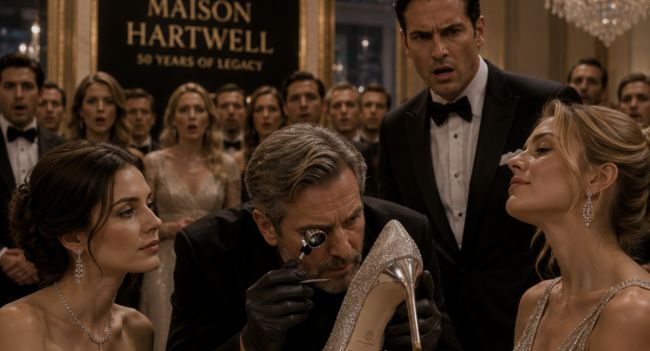
The blue dust was an invisible tracer Gabriel had placed on a resin copy of my private couture last. Six months earlier, after we discovered unexplained gaps in the archive logs, we had moved the real pearwood last into a bank vault. The replica remained behind coded glass.
Gabriel had built three microscopic defects into the decoy. There was a shifted steel pin inside the heel, a false ridge beneath the arch, and tracer powder that bonded with heated leather. Both shoes carried every marker.
That meant someone had entered the protected archive, removed the decoy, and used it during production. The access record showed that the glass case had been opened after midnight. The executive override belonged to Julian.
My husband had not accidentally approved a design that resembled mine. He had used his authority to access a protected object shaped from my body. Then he had given the result to the woman helping him remove me from my own company.
“Can he challenge this?” I asked Graham. He said anything could be challenged, but the physical evidence would survive. Julian had displayed the finished product beneath dozens of cameras before hundreds of witnesses.
Mara opened another folder. Inside was the manufacturing order that instructed Maison Hartwell’s internal sample room to produce Sloane’s shoes. The requesting company was Aurelia Creative Holdings, which belonged entirely to Sloane.
Julian had signed the authorization himself. He classified the shoes as a marketing prototype and ordered the staff not to include me in the approval process. His signature was real, not scanned or copied.
I felt something inside me turn cold. Julian had spent months telling everyone that I was too emotional to understand the company’s future. Now his own signature connected him to the archive breach and the private gift he had publicly displayed.
Sloane had claimed Julian bought the shoes for her. But when Mara turned over the invoice, his personal account did not appear anywhere. Neither did Blackwood Luxury Group’s marketing budget.
The cost was one hundred eighty-seven thousand dollars.
Mara placed one finger beneath the name of the account that had paid it. Then she looked at me and said, “Camille, he used your mother’s foundation.”
“PART 2:
Gabriel held the midnight-blue shoe beneath the chandelier. “This pair was formed on Hartwell Last Number One,” he said. Sloane laughed and claimed that Julian had already told everyone that.
Gabriel did not smile. He explained that Hartwell Last Number One did not belong to Maison Hartwell’s operating company. It was my private property, protected under the Hartwell Heritage Registry.
The room became completely silent. Julian had just announced that he personally commissioned the shoes and authorized access to the archive. Sloane was still wearing one while holding the other against her chest like a trophy.
Julian called the registry an outdated technicality. He insisted that because I worked for Maison Hartwell, the mold belonged to the company he managed. Gabriel answered calmly, “No.”
I asked Sloane to surrender the second shoe for examination. She refused and said both shoes were gifts from Julian. That was when my mother’s attorney, Mara Quinn, walked out of the rear gallery carrying a legal folder.
Mara announced that preservation notices had already been served on Maison Hartwell, Blackwood Luxury Group, Sloane’s consulting company, and Julian himself. Nothing connected to the production, payment, transfer, storage, or display of the shoes could be destroyed or removed. For the first time, Sloane looked down as if she realized she was not wearing a prize.
She was wearing evidence.
Julian leaned close and warned that I would regret humiliating him publicly. I reminded him that he had brought his mistress into my atelier, placed her in shoes molded from my body, and announced that she would replace me. He still believed the humiliation belonged to him.
Before midnight, a judge approved an emergency consent order. Sloane was forced to surrender both shoes in the coatroom while photographers waited outside. Mara collected signatures from the court officer, event security, Gabriel, and Sloane’s attorney to preserve the chain of custody.
Two hours later, the shoes rested on a linen-covered table inside my mother’s bedroom at Hartwell House. Gabriel removed the heel cap while Mara opened the evidence file. Graham Reed, the independent conservator of our archive, placed the lining beneath ultraviolet light.
A streak of blue dust suddenly glowed across the silk.
Graham stared at the shoes and said, “These were not formed on the original last.”
“PART 4:
The Vivienne Hartwell Artisan Foundation existed to train young cutters, embroiderers, and shoemakers. My mother created it so traditional craftsmanship would survive after she was gone. Julian used its money to make couture shoes for his mistress.
Gabriel looked away when he saw the invoice. The foundation had paid for his granddaughter’s apprenticeship. What Julian called a romantic gift had been funded by money intended for young artisans.
Mara explained that the payment created more than a public scandal. It triggered a clause inside the Hartwell Legacy Trust covering misuse of foundation funds and unauthorized exploitation of protected artifacts. Julian had activated both conditions with one pair of shoes.
The next morning, I entered the emergency board meeting inside Blackwood Tower. Sloane sat beside Julian wearing my mother’s diamond bracelet, although the shoes were now sealed as evidence. Representatives from Laurent-Ross were also present because Julian planned to sell Maison Hartwell for four hundred eighty million dollars.
Under that hidden deal, Julian would lead the buyer’s American luxury division. Sloane would become a global creative ambassador. I would be given an honorary title and a public story claiming I had chosen to step away.
Mara distributed the trust documents around the black stone table. She showed the board that Blackwood Luxury Group did not own the Hartwell name, the double-H insignia, the design archive, the couture lasts, the atelier building, or the private client measurements. Those assets belonged to my mother’s trust.
Without the trust’s license, Julian’s operating company could not legally make or sell a single Hartwell product. The buyer’s representatives immediately began whispering to their attorneys. Julian ordered everyone to ignore what he called a family dispute.
Then the forensic report appeared on the screen. It showed the decoy markers, Julian’s archive override, Sloane’s company order, and the foundation payment. Sloane turned toward him and demanded to know why he had told her everything was authorized.
Julian ordered her to sit down. She refused and said he had promised that I had agreed to step back. I stayed quiet while the two people who had laughed at me began blaming each other in front of the board.
Mara opened one final section of the trust. She explained that my mother had created a superior class of voting shares that remained dormant until protected property was misused. Julian’s actions had activated them automatically.
His face went pale when Mara placed the termination document in front of him.
Then she said, “Mr. Blackwood, your management authority ended at 2:47 this morning.”
Part 5 is ready. If you’re still following this story,
“PART 5:
Julian stared at the termination document and said the trust could not remove him. Mara told him he was free to challenge it in court, but the dispute would not suspend its effect. The Laurent-Ross representatives stopped treating him like the man in control.
Sloane demanded to know whether her contract still existed. No one answered immediately. She looked at Julian and realized the title, company position, and twenty-million-dollar future he had promised her depended on assets he never owned.
Julian turned to me and accused me of setting a trap. I reminded him that the archive had been locked, the ownership rules were written, and he had used his own override to remove the object. I had not tempted him to steal the decoy.
He said he had built Maison Hartwell and made me successful. I told him he had built scaffolding around a house that existed before he arrived. Then Mara slid a second legal folder across the table.
Julian did not touch it. He recognized the name printed on the cover before Sloane could read it. The document was the original financing agreement between the Hartwell Legacy Trust and Blackwood Capital.
For eleven years, Julian had told investors that he saved my family’s company with eighteen million dollars of his own money. The agreement proved that the money had actually come from my mother’s trust. Blackwood Capital had borrowed it, then reinvested it into Maison Hartwell as though Julian were our rescuer.
“He used our money to buy influence over our company,” I said. Julian demanded to know why my mother had allowed it. Mara answered that Blackwood Capital had been days from default when Julian and I became engaged.
My mother had secretly saved his company because I loved him. But she had never trusted him enough to leave the loan unsecured. The collateral section named Julian’s controlling interest in Blackwood Capital.
His attorney grabbed the document and began reading the default provisions. Fraud, willful misappropriation, or unauthorized exploitation of a Hartwell-protected asset created immediate material default. The numbered shoes connected every condition.
Sloane slowly moved her chair away from Julian. He looked from the foundation invoice to the trust termination and then to the loan agreement. For the first time, he understood that losing Maison Hartwell was not the worst consequence waiting for him.
Mara opened the final page and pointed to my mother’s signature.
“The shoes did not only return Camille’s company,” she said. “They gave the Hartwell Trust the right to foreclose on yours.”