Every summer, Hollywood tends to fill theaters with enormous action spectacles—CGI explosions, deafening sound effects and superhero franchises designed to overwhelm the senses. Then, almost as if remembering that another audience exists, the industry occasionally offers something aimed at viewers looking for romance, comedy and a little more literary charm.
In 2013, that film was Austenland, a romantic comedy built around one very specific obsession: Jane Austen.
The premise sounds almost tailor-made for Austen devotees. A woman so consumed by the world of Pride and Prejudice travels to an eccentric English resort where guests can temporarily abandon modern life and immerse themselves in a carefully constructed Regency fantasy.
There, romance is not simply something to watch on screen. It is an experience to be purchased.

A theme park built for Jane Austen devotees
At the center of the story is Jane Hayes, a single woman in her 30s played by Keri Russell. Her fascination with Jane Austen has become so intense that it has begun to interfere with her ability to navigate real-world romance.
Jane has effectively measured real men against the impossible standard of Mr. Darcy, particularly the version made famous by Colin Firth in the 1995 television adaptation of Pride and Prejudice. Her apartment reflects the obsession, and her romantic life has suffered because reality simply cannot compete with her fictional ideal.
Eventually, Jane makes an extraordinary decision: she spends her life savings on a trip to Austenland, an English resort designed to recreate the world of Austen’s novels. Sony’s official synopsis describes the destination as an eccentric resort where visitors experience complete immersion in the Regency era, complete with period clothing and activities.
Once inside, Jane and the other female guests are expected to play along with the fantasy.
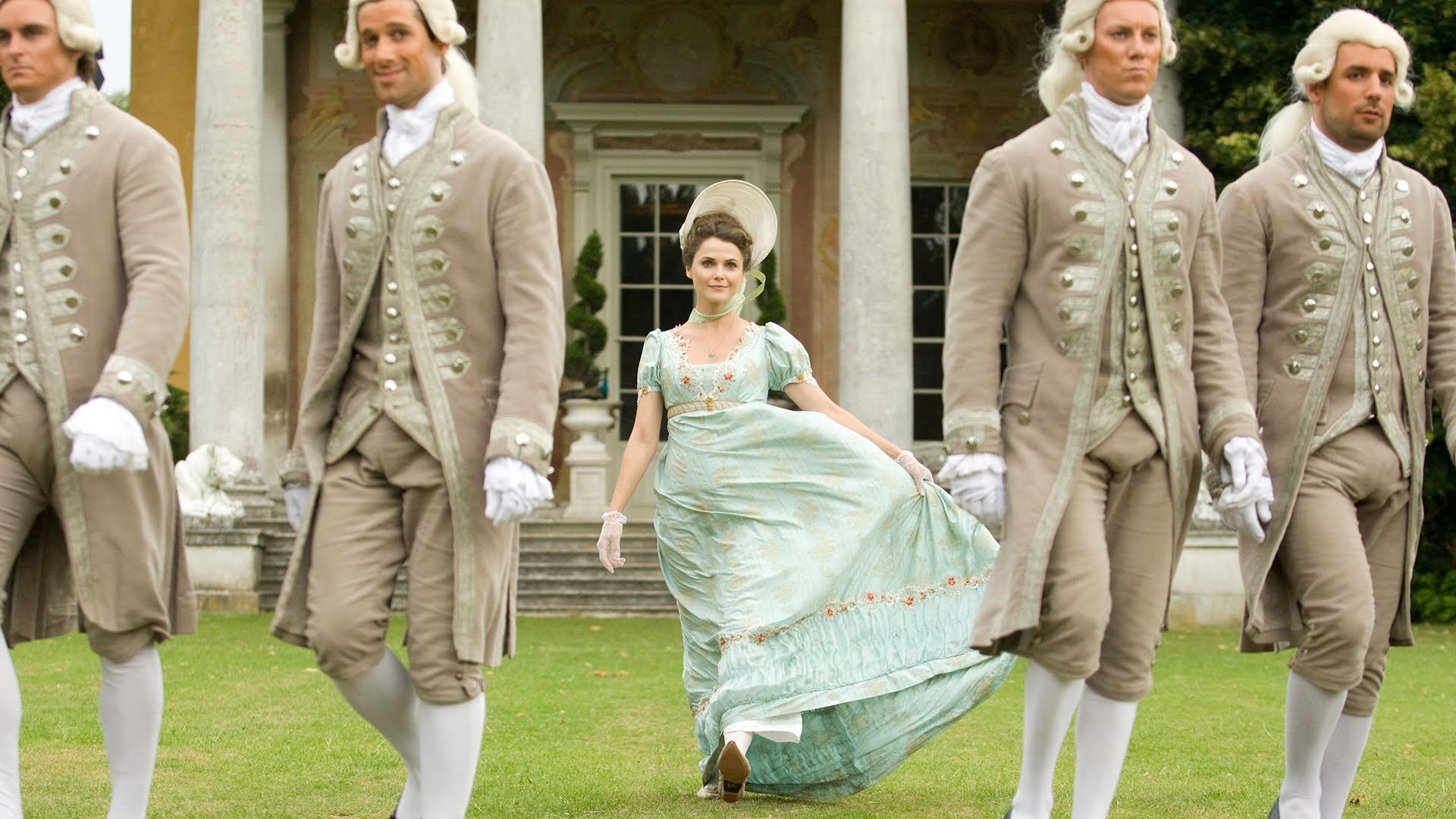
They dress in period costumes, take part in embroidery, hunting and croquet, and interact with men assigned to perform the roles of Regency gentlemen. The ultimate fantasy is obvious: perhaps one of these carefully selected suitors might become a real-life version of Mr. Darcy.
The film was adapted from Shannon Hale’s 2007 novel, with Hale also serving as co-screenwriter. Jerusha Hess directed and co-wrote the screenplay, while Stephenie Meyer, best known for creating the Twilight literary franchise, was among the producers.
An irresistible premise that does not fully deliver

On paper, Austenland has almost everything needed for an appealing romantic comedy.
It combines Jane Austen’s world with modern-day fandom, places its characters inside an elaborate period fantasy and gives them the opportunity to explore the difference between romantic fiction and real relationships.
The setting itself provides endless opportunities for comedy.
Unfortunately, the execution is considerably less consistent.
The film’s humor works only intermittently, and some scenes have the unfinished quality of an extended sketch rather than a fully developed feature-length comedy. The dialogue can feel uneven, with some lines apparently improvised in ways that do not always produce the intended laughs.
The soundtrack also occasionally pushes the comedy too hard, including the use of older pop songs such as “Bette Davis Eyes,” which can make the film’s attempts at humor feel more obvious rather than more effective.
The movie runs for 97 minutes, keeping the story relatively compact, but even within that runtime its comic tone can feel uneven.
Jennifer Coolidge goes for broad comedy
One of the most exaggerated performances comes from Jennifer Coolidge, who plays wealthy Austenland guest Miss Elizabeth Charming.
Her character is deliberately outrageous: a middle-aged woman with little interest in maintaining the decorum expected by the resort. Coolidge leans heavily into that persona, producing some genuinely funny moments but also relying on broad jokes and deliberately awkward behavior.
Her appearance was especially entertaining for audiences already familiar with her work in the American Pie films, where she became widely recognized as Stifler’s mom.
But the character is largely used as a source of comic disruption. Her attempts to sound convincingly British, her flirtatious behavior and her repeated disregard for Regency etiquette become recurring gags rather than elements of a more developed character.
The result is amusing in places, but it also illustrates one of the film’s larger problems: many potentially funny ideas are pushed so forcefully that they lose some of their impact.
Keri Russell gives the movie its heart

The film becomes considerably stronger whenever it focuses on Keri Russell’s Jane.
Russell brings an appealing warmth to the character, making Jane’s obsession with Austen understandable rather than simply ridiculous. She is not merely a caricature of a romance fan. She is a woman who has become so comfortable with fictional ideals that real relationships have begun to seem disappointing by comparison.
That makes her decision to visit Austenland more significant than a simple vacation.
Jane is effectively paying to enter a fantasy because the real world has failed to provide the kind of romance she has imagined for herself.
The irony is that once she arrives, the fantasy begins to create a new problem: how can she determine what is genuine when everyone around her has been hired to pretend?
That question sits at the center of the film. Sony’s synopsis similarly frames Jane’s journey around her struggle to determine where fantasy ends and real life—and potentially love—begins.
Enter Mr. Nobley
Jane eventually encounters the man who appears to be her Austenland equivalent of Mr. Darcy: Mr. Nobley, played by JJ Feild.
Unlike some of the broader performers around him, Feild benefits from playing his character relatively straight. His restrained approach gives the romantic side of the story a chance to breathe.
Jane is also drawn into another possible romance through Martin, the estate’s handyman, played by Bret McKenzie.
McKenzie, known as one half of the comedy-folk duo Flight of the Conchords, brings a more relaxed and playful energy to Martin. The character offers Jane something fundamentally different from the polished Regency fantasy represented by Nobley.
With two very different men occupying her attention, Jane is forced to confront the question she has been avoiding: does she actually want Mr. Darcy, or has she simply spent too long believing that she does?
Jane Seymour’s mysterious Mrs. Wattlesbrook
Another potentially fascinating character is Mrs. Wattlesbrook, the formidable owner of Austenland, played by Jane Seymour.
Seymour is an obvious fit for the role. Dressed in elaborate period costumes and presiding over the estate with imperious authority, she immediately looks as though she belongs in this carefully manufactured Regency world.
Mrs. Wattlesbrook is responsible for shaping the fantasy experienced by each guest, effectively determining how their individual stories will unfold.
But the film never fully explains the motivation behind her elaborate operation.
Why does she run Austenland? What does she ultimately gain from constructing these elaborate romantic fantasies? And why does she seem particularly determined to make Jane’s stay miserable after Jane arrives on a cheaper package?
Those unanswered questions leave an important part of the film’s world underdeveloped.
There are also small inconsistencies that weaken the illusion. Modern technology such as cellphones is prohibited, yet some modern tools are perfectly acceptable when the guests are making their period bonnets.
A fantasy about fantasy itself

At its best, Austenland understands something important about Jane Austen fandom.
The resort works because its guests willingly participate in an elaborate performance. They know they are entering an artificial world, yet they pay for the opportunity to behave as though it were real.
That creates the film’s most interesting tension.
Jane arrives wanting to meet her ideal man, but the entire environment is designed to blur the boundary between performance and genuine emotion. Every romantic gesture could be part of the program. Every apparent rejection could have been scripted. Even the men she meets may simply be playing roles.
The premise therefore has the potential to say something meaningful about the way romantic fiction influences expectations of real relationships.
The problem is that the movie does not always explore that idea as deeply as its setup promises.
A charming idea with uneven execution

Austenland was released in 2013 and premiered at the Sundance Film Festival before Sony Pictures Worldwide Acquisitions acquired worldwide rights, with Sony Pictures Classics handling its North American theatrical distribution.
It is ultimately a film that is easier to appreciate for its concept than for its consistency.
For devoted Jane Austen fans, the elaborate costumes, Regency setting, romantic archetypes and constant references to Pride and Prejudice provide plenty to enjoy. The movie was clearly made with an audience of Austen enthusiasts in mind, and its playful approach to that fandom gives it a distinctive identity.
But for viewers less invested in Austen’s world, the broad comedy and uneven dialogue may become frustrating.
The strongest element is arguably Jane herself. Through Keri Russell’s performance, the film finds an emotionally recognizable woman hiding behind the exaggerated Austen obsession—a woman who has to discover whether the romance she has been chasing belongs in a book or can actually exist in her own life.
That gives Austenland a promising foundation.

Yet despite its clever premise, talented cast and unusual setting, the film never completely transforms that foundation into the sharp, sophisticated romantic satire it might have been. It wants to be both a loving tribute to Austen fandom and a comedy about the absurdity of that obsession, but it does not always balance the two.
For Austen devotees, that may be enough.
For everyone else, the experience can feel like an elaborate romantic fantasy that never quite achieves its own happily-ever-after.