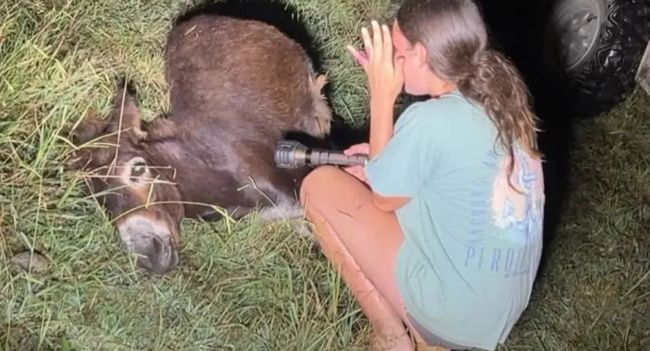
HeeHaw’s Death Sparks Federal Lawsuit and Calls for Answers in Georgia
A beloved miniature donkey named HeeHaw was killed during a late-night search for a missing child in Georgia. Now, his owner is taking the case to federal court, while one question continues to loom over the controversy: why did police enter the pasture where HeeHaw was kept, and what happened in the moments before he was shot?
HeeHaw was fatally shot shortly after midnight on Aug. 30, 2026, at Elsberry Riding and Farm on Grady Road in Polk County. Officers were searching the area for a missing 12-year-old girl, who was later found safe.
The shooting has since prompted a federal civil rights lawsuit, a $1 million legal demand and calls for the release of police and drone footage that could provide more information about the encounter.

What happened in the pasture?
According to Officer Trenton Ryan Garner’s account, the confrontation began when HeeHaw approached the search team and allegedly charged toward officers and members of a K-9 team.
A K-9 handler attempted to deter the donkey by activating a Taser, but Garner said the attempt did not stop HeeHaw from continuing toward the group.
Garner then fired a shot, saying he did so to protect the K-9 handler and members of the search team from being injured. HeeHaw moved back up a hill before collapsing, according to the officer’s report.
No criminal charges have been filed against Garner in connection with the shooting. He was placed on administrative leave while the Georgia Department of Agriculture’s Law Enforcement Division conducts an outside investigation.
But the officer’s version of events is sharply disputed by HeeHaw’s owner, Hannah Israel.
Israel has described HeeHaw as a young, bottle-raised miniature donkey who was accustomed to people and regularly interacted with the public, including at petting zoos. Her account challenges the characterization of the animal as an immediate threat.
The question over how officers entered the pasture
The circumstances surrounding the officers’ presence on the property have become a central issue in the case.
Israel alleges that officers entered her enclosed pasture without her permission or a search warrant while looking for the missing girl. The federal lawsuit, filed Sept. 11 in the U.S. District Court for the Northern District of Georgia’s Rome Division, makes the same allegation.
The complaint argues that there was no warrant, consent or emergency that legally justified the entry and alleges violations involving unlawful search and entry, unreasonable seizure and destruction of property, and deprivation of property without due process.
Police, meanwhile, were conducting an active search for a missing child at the time. The girl was ultimately found safe.
That leaves the circumstances surrounding the encounter — including why the search entered the pasture and what happened immediately before the shooting — at the center of the dispute.

Body-camera and drone footage could provide more answers
There is potentially important evidence that could help establish what happened that night.
Body-camera footage from officers has been preserved, and a drone operated by the Rockmart Fire Department was assisting with the search. Israel and supporters have called for both recordings to be made public.
As of the latest reports, however, the footage had not been publicly released. That has left the public largely reliant on the conflicting accounts provided by law enforcement and HeeHaw’s family.
The absence of the footage has become particularly significant because the central dispute is not simply whether HeeHaw was shot, but whether the use of deadly force was justified and how the encounter unfolded inside the pasture.

HeeHaw’s owner takes the fight to court
The controversy has now moved firmly into the legal system.
Attorney Christopher McCormick, representing Israel, filed a federal lawsuit against Garner and also sent a $1 million legal demand to the City of Cedartown, the Cedartown Police Department and the Cedartown Board of Commissioners.
The city and related entities were given 30 days to respond to the demand, according to McCormick. The federal lawsuit names Garner individually rather than the city or police department as defendants.
Israel is seeking compensatory and punitive damages, along with attorneys’ fees, court costs and interest. The complaint also requests a jury trial.
The legal action adds a new dimension to a case that has already drawn significant public attention.
Protests grow as investigation continues
The shooting has also prompted demonstrations calling for accountability and justice for HeeHaw.
A “Justice for HeeHaw” rally was held outside the Polk County Courthouse, with tensions reportedly escalating during the event. The controversy surrounding the donkey’s death has continued to draw strong reactions from people who believe more information should be released about the encounter.
For Israel, the issue goes beyond the loss of a beloved animal.
She has questioned why HeeHaw and the search team came into contact in the first place and whether the encounter could have been handled without deadly force.
HeeHaw was not simply an animal kept on the property. According to his family, he had been bottle-raised and was deeply integrated into their lives, making his death especially painful for those who knew him.
Now, the federal lawsuit and the ongoing investigation may provide a clearer picture of what happened during those crucial moments in the pasture.
Until more evidence is released and the legal proceedings move forward, the central question remains: why did the search for a missing child lead officers into HeeHaw’s pasture — and could his death have been prevented?