
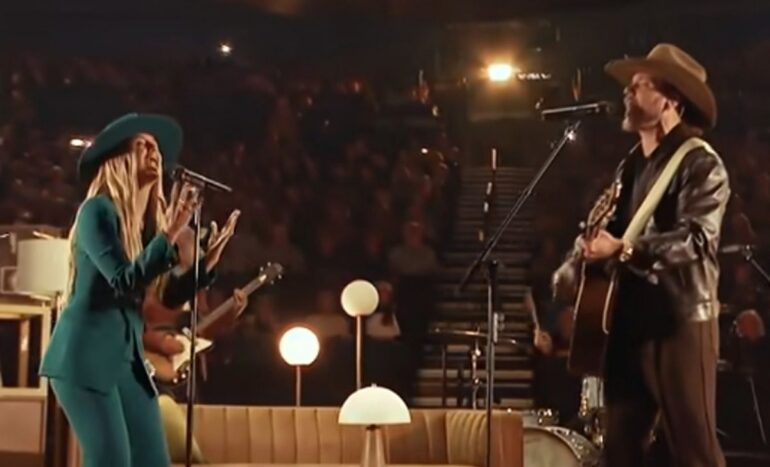
Lainey Wilson and Brandon Lake brought a powerful message of faith, grace, and forgiveness to the 57th Annual GMA Dove Awards, delivering a heartfelt performance of their collaboration, “The Jesus I Know Now.” The song, which earned the duo the award for Country/Roots Recorded Song of the Year, explores how personal experiences can reshape our understanding of Jesus and the role faith plays in our lives.
Released in April 2026, the song brings together two artists from different musical backgrounds who share a common message. Written by Lake and Wilson alongside Emily Weisban and Luke Laird, “The Jesus I Know Now” grew out of conversations about the misconceptions and distorted teachings about the Bible they had encountered throughout their lives.
Rather than presenting faith through a lens of judgment and fear, the song reflects a more personal understanding of Jesus, one rooted in compassion, friendship, and unconditional love.
A Different Understanding of Jesus
Brandon Lake opens the song by reflecting on the image of Jesus he grew up hearing about. The opening verse describes a figure who seemed angry, disapproving, and ready to condemn anyone who failed to follow a strict set of rules.
He sings about being told that Jesus would save him only if he attended church, stayed quiet, and avoided behaviors such as smoking, drinking, or cursing. Those expectations left him with the impression that even small mistakes could put him on a path toward eternal punishment.
The verse closes with a realization that changes the meaning of everything that came before it: he thought he understood Jesus until he encountered Him for himself.
That distinction is at the heart of the song. Lake and Wilson reflect on how their early understanding of God was shaped by fear and rigid expectations, only to discover a more compassionate relationship with Him as they grew older.
The message is especially compelling because it speaks to people who may have struggled with religion or felt that faith was defined primarily by rules, judgment, and the fear of doing something wrong.
Instead of focusing on those restrictions, the song emphasizes the possibility of finding a personal connection with Jesus that is built on love and forgiveness.

Lainey Wilson Opens Up About Finding Fulfillment Beyond Success
One of the song’s most striking moments comes during Lainey Wilson’s solo verse, when she reflects on the difference between achieving her dreams and finding genuine fulfillment.
She describes getting what she wanted, including hearing her song on the radio, yet discovering that professional success did not necessarily bring the peace or happiness she expected.
Despite reaching a point where everything appeared to be going her way, she found herself with an empty heart and nowhere else to turn.
The verse captures a deeply personal contradiction. From the outside, Wilson’s career represented the kind of success many aspiring musicians spend years pursuing. She had achieved meaningful milestones, earned recognition, and reached a position that countless artists would love to occupy.
Yet those accomplishments could not fill the emotional void she describes in the song.
Her answer was to return to the arms of the Jesus she knows now.
That admission gives the song an additional layer of meaning. Wilson acknowledges that even when life looks perfect to everyone else, a person can still feel lost. Career achievements, public recognition, and other outward signs of success do not automatically provide a sense of purpose or inner peace.
The song presents faith as the place where she found a different kind of fulfillment, one that goes beyond professional accomplishments.
Its chorus reinforces that idea by describing Jesus not as a distant voice in the clouds or someone concerned with collecting trophies, but as a friend who welcomes outsiders, listens without judgment, and continues to forgive.
It is an honest and relatable message, particularly for anyone who has discovered that reaching a long-held goal does not always deliver the happiness they imagined.

Brandon Lake Has Built Strong Connections With Country Music
For listeners who recognize Brandon Lake’s name, his collaboration with Wilson is another example of the growing connection between contemporary Christian music and country.
Lake is widely known for his hit song “Gratitude,” and he has also worked with several prominent country artists.
His collaboration with Jelly Roll on “Hard Fought Hallelujah” brought together two artists whose musical backgrounds differ but whose work often explores personal struggles, redemption, and the search for meaning.
More recently, Lake teamed up with Cody Johnson on “When A Cowboy Prays,” another collaboration that highlights the natural overlap between Christian and country music.
These partnerships make sense given the long history shared by the two genres. Country music has frequently drawn on themes of family, hardship, faith, and perseverance, while contemporary Christian music often tells stories of personal transformation and hope.
Although the sounds and audiences can differ, the emotional foundations of both styles often intersect.
That connection has become increasingly visible as Christian music reaches a wider mainstream audience.

Christian Music Continues to Gain Mainstream Attention
The growing visibility of Christian music was particularly notable in May 2025, when two Christian songs appeared on the Billboard Hot 100. According to the report cited by Whiskey Riff, it was the first time in more than a decade that two Christian songs had made the chart during the same period.
One of those tracks was Forrest Frank’s viral hit “Your Way’s Better.” The other was Lake’s “Hard Fought Hallelujah.”
The success of these songs reflected a broader moment for Christian music, with artists finding audiences beyond traditional church settings and Christian radio.
Collaborations with mainstream performers have also helped introduce faith-centered music to listeners who might not ordinarily seek it out.
Wilson and Lake’s partnership fits naturally into that trend. By combining Wilson’s country roots with Lake’s contemporary Christian sound, the two artists bring a message of faith to audiences across both musical worlds.
Their collaboration also demonstrates how songs about religion can connect with listeners through universal experiences, including loneliness, disappointment, self-discovery, and the desire to find acceptance.
A Standout Moment at the 57th Annual GMA Dove Awards
At the 57th Annual GMA Dove Awards, Wilson and Lake took the stage to perform “The Jesus I Know Now” for only the second time.
The performance followed the duo’s win for Country/Roots Recorded Song of the Year, giving the song an especially meaningful place in the evening.
The award recognized their work on a track that combines country storytelling with a contemporary Christian message. Its focus on personal faith and the difference between outward appearances and inner peace gives it an emotional weight that extends beyond genre boundaries.
For Wilson, the performance also offered an opportunity to highlight something that has remained important to her throughout her career: her faith.
She grew up attending church and continues to speak openly about her beliefs, even as she has become one of the biggest stars in mainstream country music.
That willingness to bring her faith into the spotlight is part of what makes the collaboration stand out. Wilson has a substantial platform, and songs like this allow her to share a more personal side of herself with fans.
It is also easy to imagine her exploring Christian music more extensively in the future. A dedicated Christian or gospel album could give her room to interpret traditional gospel standards alongside more contemporary worship songs.
Given her background in church and her experience as a country performer, such a project would be an interesting direction for her to pursue.
Why “The Jesus I Know Now” Resonates
What makes “The Jesus I Know Now” particularly effective is its emphasis on love and forgiveness rather than condemnation.
Conversations about religion in mainstream popular culture can sometimes become focused on rules, divisions, and the ways people fall short of expectations. The song offers a different perspective, presenting Jesus as someone who welcomes people who feel out of place and offers forgiveness even when they have made mistakes.
That message comes through in both Lake’s opening verse and Wilson’s reflection on success and emptiness. Their experiences are different, but they arrive at a similar realization: understanding faith personally can be very different from accepting someone else’s assumptions about it.
The song’s appeal lies in that sense of discovery. It does not portray a perfect life or suggest that worldly success eliminates personal struggles. Instead, it acknowledges that people can feel lost even when everything appears to be going well, and that finding meaning sometimes requires looking beyond the things they once believed would make them happy.
The collaboration also feels like a natural meeting point for two artists whose musical styles and personal experiences allow them to approach the subject from different angles.
Hopefully, this will not be the last time Wilson and Lake work together. Their partnership brings out the strengths of both artists while giving them an opportunity to share a message that clearly matters to them.
For now, their Dove Awards performance offers a memorable reminder of what can happen when country storytelling and contemporary Christian music come together around a message of faith, acceptance, and forgiveness.
Watch Lainey Wilson and Brandon Lake perform “The Jesus I Know Now” at the 2026 GMA Dove Awards:
Watch the official lyric video: