ZZ Top’s Unforgettable First Late-Night Television Appearance With Johnny Carson
By 1986, ZZ Top had already become one of the biggest rock bands in the world. The enormous success of 1983’s Eliminator had transformed Billy Gibbons, Dusty Hill and Frank Beard into MTV icons, but there was still one television milestone the Texas trio had yet to reach: a late-night performance of their own songs.
That changed on May 18, 1986, when ZZ Top appeared on The Tonight Show with Johnny Carson for their first late-night television performance.
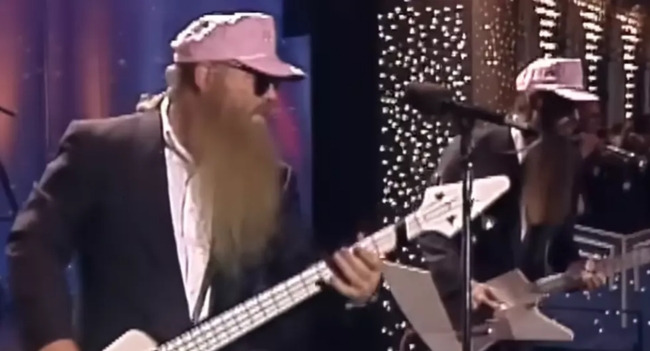
The appearance was memorable for reasons that went well beyond the songs themselves. ZZ Top were promoting their 1985 album Afterburner, yet they chose not to perform anything from it. Instead, they delivered unusual, horn-heavy versions of “Sharp Dressed Man” and “Tush,” accompanied by the NBC Orchestra under the direction of legendary bandleader Doc Severinsen.
The performance took an even stranger turn when Severinsen joined the visual joke. Trumpet in hand, he appeared wearing a fake beard and sunglasses, adopting the unmistakable look associated with Gibbons and Hill.
Johnny Carson got in on the gag, too. As the smoke from the performance cleared, Carson could be seen behind his desk wearing a ZZ Top-style beard and hat.
It was an unusually playful moment for a band whose career had been built, in part, around carefully controlling how much the public could see of them.
Doc Severinsen Remembered His Brief Career as a ZZ Top Member
Decades later, Severinsen still remembered the experience.
In an email to author Christopher McKittrick, he offered a characteristically cheeky assessment of his temporary membership in ZZ Top: “I was glad to have that unique experience as a ZZ Top ‘member.’ My sex life improved immediately.”
Severinsen was already well into his 90s when he shared the recollection with McKittrick.
For McKittrick, the quote became one of the most memorable responses he had ever received while researching a book. The author had become fascinated by the unusual television appearance and decided to contact Severinsen’s publicist to find out whether the bandleader remembered the occasion.
“I just thought that [television performance] was so wild that I wanted to at least attempt to reach out to his publicist and see, does he even remember this moment and can he talk about it?” McKittrick tells UCR. “And he just gave me the briefest quote about it. But I have to say, in all my years of writing, it’s my favorite quote that I’ve ever gotten from someone when writing a book. It says it all, with his humor.”
The performance became one of the distinctive episodes McKittrick explored in his 2024 book, Gimme All Your Lovin’: The Blues, Boogie and Beard of Billy F. Gibbons.
Why ZZ Top Stayed Away From Late-Night Television
The fact that ZZ Top waited so long to make a late-night television appearance was no accident.
Much of the band’s early career was shaped by manager and producer Bill Ham, who maintained unusually tight control over the group’s public image. Ham believed that limiting television appearances and media exposure could make the band more mysterious and encourage fans to experience ZZ Top in person.
According to McKittrick, Ham wanted virtually every aspect of the group to retain an air of mystery, including the origins of the band’s name and even the musicians’ appearances.
That philosophy was evident on ZZ Top’s early album covers, which often featured distant photographs rather than revealing close-up portraits of the three musicians.
“Bill had this idea that he wanted to keep everything about ZZ Top kind of a mystery, from how they got their very unique band name to what the members even looked like,” McKittrick says. “If you look at a lot of the early albums, we see a lot of faraway pictures of them, but not really up close and personal, which is really ironic. Years later during the MTV era, when you couldn’t [miss them] on TV, they were all over the place.”
Ham was particularly reluctant to put ZZ Top on programs such as The Midnight Special and other music shows.
“At the time, Bill Ham had this idea that, ‘I don’t want to have ZZ Top on the Midnight Special and other shows like that. I want fans to come to the concert, see what they look like and hear what they sound like live,’” McKittrick explains.
The strategy worked. ZZ Top built an enormous following through touring and became a major concert attraction without relying heavily on television exposure.
Then MTV changed the rules.
Once music videos became central to the way rock stars reached audiences, ZZ Top had to embrace television on a much larger scale. The band ultimately became one of the defining video acts of the 1980s, with Gibbons, Hill and Beard turning their beards, sunglasses and eccentric visual style into an essential part of their identity.
Their transformation was remarkable considering how carefully Ham had previously kept them out of the television spotlight.
Even years later, the members of ZZ Top credited Ham with playing a crucial role in keeping the band together and building its career. In 2016, drummer Frank Beard said, “I truly think the band would have broken [up] in three years if Bill hadn’t been involved.”
ZZ Top Had Already Made Television History Before Johnny Carson
There is an important distinction to the Carson appearance. Although the May 18, 1986 performance was ZZ Top’s first late-night television appearance playing their songs, it was not their first televised concert.
That milestone came much earlier, during the band’s appearance on Germany’s Rockpalast in 1980.
According to the official Rockpalast archive, ZZ Top’s performance at Essen’s Grugahalle was the band’s first appearance outside the United States and the first time the group accepted an offer to perform a television concert. The April 19-20, 1980 appearance helped introduce the Texas trio to a much wider European audience.
That distinction makes the Carson appearance all the more interesting. ZZ Top had already demonstrated that they could command a television stage, but they had spent years largely avoiding the conventional late-night circuit.
By the time they finally appeared with Carson, they had already become international stars.
The 1980 Rockpalast Performance Remains Essential ZZ Top Footage
For fans looking for classic-era ZZ Top performances, the Rockpalast concert remains one of the most important recordings available.
The band was touring behind 1979’s Degüello, and the performance captures Gibbons, Hill and Beard before the synthesizers, sequencers and elaborate MTV-era production that would define much of their 1980s image.
The complete concert runs roughly 90 minutes and features a set packed with material from the band’s early catalog. The group performs staples including “Waitin’ for the Bus,” “Jesus Just Left Chicago,” “Cheap Sunglasses” and “Tush.”
The set also reaches deeper into the catalog with “Precious and Grace” from Tres Hombres, “Manic Mechanic” from Degüello and an extended performance of “A Fool for Your Stockings,” also from Degüello.
The official Rockpalast archive identifies the Essen concert as a landmark in the band’s history. ZZ Top closed the 1980 Rocknacht and performed for a crowd in the Grugahalle, with the Eurovision broadcast helping make the group widely known across Europe.
The performance has since remained available in home-video and streaming releases, giving fans a chance to see the original trio at a particularly revealing point in its career. The concert was recorded just as ZZ Top was moving from its Texas blues-rock roots toward the larger international profile that would arrive a few years later.
More Rare ZZ Top Footage Emerged Later
Official live footage from ZZ Top’s classic period has never been especially abundant, which makes surviving performances particularly valuable.
The 2019 documentary That Little Ol’ Band From Texas helped uncover additional material, including approximately 17 minutes of previously unseen pre-Eliminator concert footage from the estate of Bill Ham, who died in 2016.
The documentary also features Gibbons, Hill and Beard performing together at Gruene Hall in Texas without an audience. The intimate session was filmed specifically for the documentary and later became more than a piece of film history.
Material from the Gruene Hall sessions was eventually issued in audio form on RAW: That Little Ol’ Band From Texas. The album came from recordings made with the original lineup during the documentary project, with the band performing together in the historic Texas venue. ZZ Top’s official site describes the session as a return to the group’s early recording approach, with the three musicians playing together in the same room.
Where to Find ZZ Top’s Other Classic Performances
Following Dusty Hill’s death in 2021 and Frank Beard’s death in August 2026, interest in surviving footage of the classic ZZ Top lineup has naturally grown.
Hill’s death marked the end of an era for the original trio, while Beard’s passing removed another central figure from the lineup that had remained together for decades.
For anyone wanting to revisit the band’s live history, Rockpalast remains one of the essential starting points. Live From Texas, filmed in the Dallas/Fort Worth area in 2008, provides another substantial concert document, while the band’s 2013 performance at the Montreux Jazz Festival offers a later look at ZZ Top onstage.
The Gruene Hall performances captured for That Little Ol’ Band From Texas provide something different: a stripped-down setting that brings the focus back to Gibbons, Hill and Beard playing together.
And then there is the Johnny Carson appearance.
It lasts only a fraction of the time covered by the full Rockpalast concert, but it captures something that makes ZZ Top’s story so unusual. A band whose early career was built around mystery eventually became one of television’s most recognizable acts, and when it finally stepped onto the Tonight Show stage, the host and orchestra decided to play along with the image.
Doc Severinsen put on the beard and sunglasses. Carson did the same. ZZ Top played two familiar songs in arrangements that fans were unlikely to have heard from them before.
For a band that had spent years keeping its distance from late-night television, it was an appropriately strange way to make its entrance.