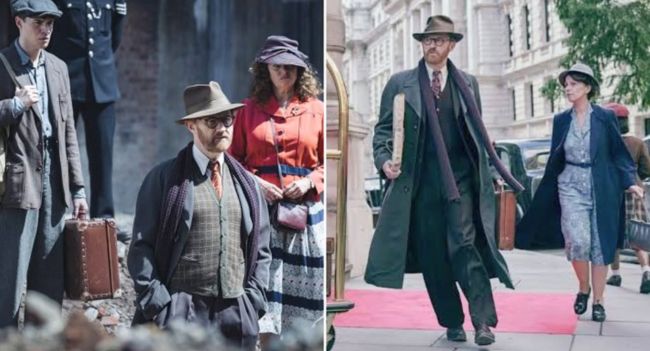

A 1940s London bookseller, a bomb-damaged city, unexplained deaths and a collection of eccentric characters who drift through the doors of his shop: Bookish has all the ingredients of a classic British mystery, but its journey to the page is rather unusual.
Unlike the vast majority of crime dramas that begin as novels before being adapted for television, Bookish went in the opposite direction. The television series premiered in the UK on July 16, 2025, while Matthew Sweet’s book followed as a literary expansion of the six-episode story. Sweet co-wrote the television series with Mark Gatiss, who also plays the central character, Gabriel Book.
The book is structured as three linked novellas, with each mystery corresponding to a two-episode television story: Slightly Foxed, Deadly Nitrate and Such Devoted Sisters.
That unusual order immediately raises an interesting question: what happens to a mystery when it is written after the television version rather than adapted from an existing novel?
A bookseller with an unusual side job

The story begins in London in 1946, where Gabriel Book runs a second-hand bookshop and spends his spare time helping the police untangle difficult cases.
Book is highly educated, eccentric and unconventional, but his greatest resource is arguably the shop itself. His knowledge of books and the strange assortment of people who pass through his doors repeatedly become useful when a murder needs solving.
He is married to Trottie, who owns the wallpaper shop next door. Around them is a loose collection of outsiders and troubled characters, including Nora, a sometime bookseller with an interest in true crime, and Jack, whose arrival at the shop turns out to be connected to Book’s own past.
The television series presents Book as a kind of semi-Sherlock figure, using his intelligence and curiosity to insert himself into police investigations. Contemporary reviews praised the show’s carefully constructed post-war atmosphere and its mixture of cosy mystery, melancholy and period detail.
The book, however, has a slightly different challenge: it has to turn that television world into prose.
The framing story that sits outside the mysteries
The three cases are surrounded by a framing device set in 1962.
In this later period, Gabriel receives an unpublished typescript from Nora, who has since become a famous author. The manuscript recounts the cases that make up the three novellas.
The idea provides a link between the mysteries and suggests that there are still secrets surrounding Gabriel and Nora. Their correspondence hints that Nora knows things about Gabriel’s past that could potentially cause trouble.
Yet this was one of the elements of the book that felt least necessary.
The framing story creates an initial sense of mystery, but because the reader is eventually taken back to the 1940s for the actual cases, the opening can feel more like a device for generating curiosity than an essential part of the narrative.
Starting directly in post-war London might have created a stronger opening and allowed more immediate time with Gabriel, Trottie, Jack and the world of the bookshop.
Novella One: Slightly Foxed
The first mystery has the difficult job of introducing the central characters while establishing the atmosphere of post-war London.
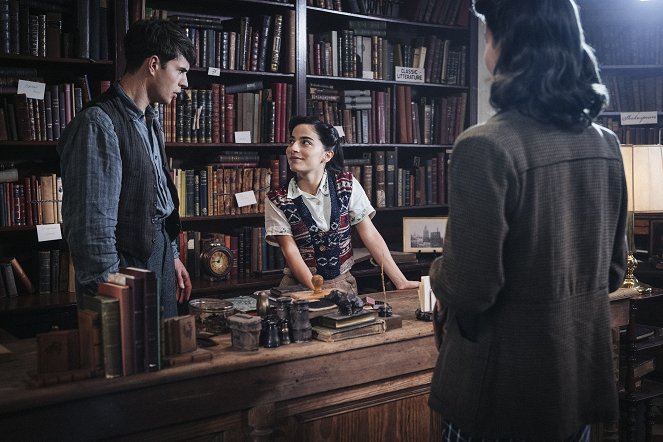
Jack Blunt has just been released from prison. Rather than simply returning to his old life, he follows the address attached to his suitcase and arrives at Gabriel Book’s shop.
What makes the situation immediately strange is that Book has apparently offered Jack a job despite never having met him before.
Jack provides an effective outsider’s perspective on London in 1946. Having spent a significant portion of the Second World War in prison, he is particularly struck by how much the city has changed.
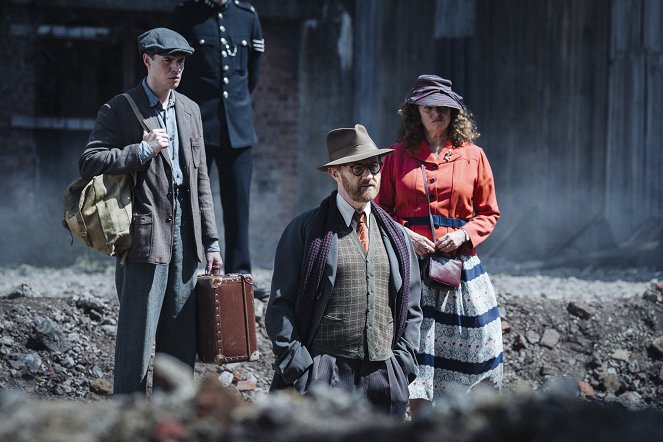
The physical destruction is everywhere. Bombing has left buildings damaged and streets transformed, giving the city a wounded appearance that fits naturally with the darker side of the mystery.
The book captures this through images of London’s damaged architecture, where once-elegant buildings now appear to be barely standing.
Jack is also an outsider in another sense. He is not particularly interested in books, which makes his arrival at a bookshop run by an intensely literary man an amusing contrast.
The apostrophe argument
One of the earliest exchanges between Jack and Book revolves around the shop’s name: Book’s Books.
Jack initially assumes the apostrophe is simply a mistake. Book, naturally, disagrees.
The argument becomes a miniature introduction to Gabriel’s personality. Grammar, language and books are not minor details to him; they are matters worth defending with extraordinary seriousness.
It is easy to imagine the scene working particularly well on screen, where Mark Gatiss’s performance can carry the eccentricity and timing of the exchange.
That impression is reinforced by the fact that Bookish was designed as a highly visual period mystery. The television series was praised for its detailed reconstruction of post-war London, from bomb-damaged streets to everyday details of life after the war.
Skeletons beneath the bombsite
Jack has barely settled into his new surroundings when a disturbing discovery changes the direction of the story.
A bombsite has become the site of an excavation, and the ground gives way to reveal the bones of dozens of people.
The discovery initially seems to be a separate mystery, but it becomes connected to the larger investigation.
The police are also dealing with the apparent suicide of a local pharmacist. Book, naturally, is not convinced that the death is as straightforward as it first appears.
This gives the opening novella two strands: the strange discovery beneath the bombsite and the suspicious death of the pharmacist.
The television version makes the structure especially clear. The first two episodes involve the bombsite skeletons alongside the investigation into pharmacist Harkup’s death, with further clues including a missing jade figurine and an unexpected beneficiary in Harkup’s will.
On the page, however, the eventual solution is less satisfying.
Some of the information Book uses is not available to the reader, while parts of his investigation take place off the page. His final deduction therefore feels as though it arrives partly from information the reader was never given.
That kind of structure can work more naturally on television, where a montage, visual clue or flashback can reveal information without lengthy explanation.
Trottie stands out
One of the strongest aspects of the first novella is Trottie.
It would have been easy for her to become nothing more than the supportive wife standing in the background while her husband solves murders. Instead, she has her own history and personality.
She is also involved in the investigations, sometimes helping Book directly and sometimes becoming involved in conversations with suspects.
By contrast, not every recurring character receives the same level of purpose.
Jack and Nora can occasionally feel as though they have been left on the sidelines. Nora is particularly vulnerable to becoming redundant because the framing story gives her a specific function as the person who records Book’s cases, but that does not always translate into an active role within the mysteries themselves.
Interestingly, Book’s relationship with Inspector Bliss becomes more important as the stories progress.
A bookshop in chaos
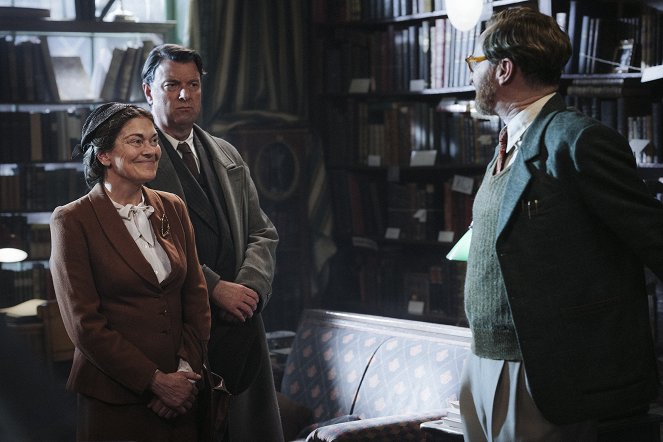
The book also has fun with Gabriel’s relationship with his own collection.
Book does not arrange his shelves according to a system that makes obvious sense to anyone else. There are private connections between books, but Jack sees only disorder.
When Book is away, Jack decides to tidy things up.
For Gabriel, this is not helpful housekeeping. It is practically sacrilege.
The humour works particularly well because it reveals something fundamental about Book: his eccentricity is not simply an affectation. His books are part of the way he understands the world.
That kind of joke feels especially suited to television, where the horror on Book’s face at seeing his carefully constructed chaos reorganised could be played visually.
Novella Two: Deadly Nitrate
The second mystery moves from the bombsites of post-war London to the glamour of a film production.
A film crew arrives on Book’s street and uses his shop as part of the production. The sudden presence of actors, crew members and admirers creates a very different atmosphere.
At the centre are Sandra Dare and Stewart Howard, the film’s two leading performers, who are also engaged.
Howard’s good looks attract plenty of attention, including from two women with walk-on roles, Barbara and Linda.
The atmosphere of rivalry is already present before the murder occurs.
Then Barbara steals chocolates intended for the film’s stars — and dies after being poisoned with strychnine.
The case immediately becomes more complicated.
The television version similarly places the film crew at the centre of the second two-part mystery, with Book and his associates trying to identify the killer before another attack occurs.
More time with the characters
Of the three stories, the second feels stronger in its setup because the reader has more opportunity to spend time with the characters.
That is particularly important when a television story is transformed into prose.
On screen, actors can communicate personality through expressions, pauses, gestures and relationships. In a novella, that depth has to be created through the writing itself.
Here, Trottie once again becomes an important part of the investigation rather than merely observing Book’s work.
The mystery itself, however, has some weaknesses.
One important clue is withheld from the reader, making the solution difficult to reach fairly. The circumstances surrounding the second death are also easier to anticipate, particularly when it comes to the victim and the person responsible.
A personal development involving Book also emerges during this story, but its presentation feels abrupt. Rather than creating a strong emotional impact, the revelation largely confirms information the reader already suspects.
That may play differently on television, where performance and visual storytelling can add emotional weight to a scene.
Novella Three: Such Devoted Sisters
The final novella begins with Trottie, rather than Gabriel.
It opens with Captain Victor Orr dying after being poisoned, and Trottie finds herself connected to the circumstances surrounding his death.
The case takes place at the Walsingham Hotel and introduces two exiled Balkan princesses who fear that an old blood feud may be connected to the murder.
The television episode description similarly centres on Captain Orr being killed by a poisoned cocktail, with Trottie among the potential suspects and the two exiled Princesses of Scutari questioning whether Orr was actually the intended victim.
The opening is arguably the most effective of the three because it creates immediate curiosity about both Trottie’s position and the circumstances of the death.
There is also more of a thriller atmosphere here, particularly once the story moves into the hotel at night.
Book becomes involved partly because of his ability to locate an obscure book concerning Balkan blood feuds, demonstrating once again how his knowledge of literature can become an investigative tool.
A recurring problem with the mysteries
There is, however, an unfortunate repetition across the three novellas.
Poison plays a role in all of them, while the question of whether the victim was actually the intended target also appears in the second and third stories.
That repetition makes the cases feel less varied than they could have been.
Nora’s role is even smaller here, while Jack has only a limited part in the investigation. He speaks to a few people, but much of the actual mystery unfolds without him.
His importance is more closely connected to the personal storyline running beneath the cases, although that aspect is resolved rather quickly.
The solution also relies heavily on information that takes place away from the page. Once again, this raises the question of whether some of those missing investigative steps are handled differently in the television version through visual storytelling.
The final novella does, however, retain the book’s playful relationship with language and literature. A conversation involving Trottie and Book turns an awkward encounter at Foyles into another characteristically literary joke.
Where Bookish Works — and Where It Falls Short
Taken individually, the three mysteries have plenty to recommend them.
The post-war setting is distinctive, the bookshop gives the series a strong identity, and Gabriel Book is an appealingly eccentric detective.
There is also a clear affection for classic British mystery fiction. The humour frequently comes from books, language, grammar and the collision between Book’s intellectual world and the more ordinary people around him.
The television series itself has been well received for precisely these qualities. Reviews have highlighted its carefully constructed period atmosphere, intricate mysteries and affectionate relationship with the cosy-crime tradition.
The main weakness of the book is that the novella format sometimes feels too restrictive.
Each mystery has only a limited amount of space to establish the setting, develop the characters, introduce suspects, plant clues and provide a satisfying resolution. As a result, characterisation can feel thinner than the premise deserves.
This is particularly noticeable with the supporting cast.
Nora and Jack are introduced as potentially important members of Book’s unusual circle, but they are not consistently given enough to do. Trottie fares considerably better because she has a stronger personality and more meaningful involvement in the cases.
The investigations themselves also occasionally depend on discoveries made away from the page, leaving the reader with less information than Book possesses.
For a television mystery, that can be compensated for by performance, editing and visual clues. In prose, it can make the final solution feel less earned.
A promising idea that might have benefited from a full novel
Ultimately, Bookish has a premise that feels bigger than the three novellas allow.
A 1940s bookseller solving murders in a bomb-damaged London is an appealing concept, and the combination of literary humour, period atmosphere and crime gives the series a distinctive identity.
But the book does not always make full use of that potential.
A single novel might have allowed more space for Gabriel, Trottie, Jack, Nora and Inspector Bliss to develop naturally alongside a larger central mystery. Instead, the three linked stories move relatively quickly from one case to another.
The result is enjoyable in places and often charming, but uneven.
For readers who enjoy cosy mysteries, literary jokes and post-war British settings, there is certainly something appealing here. The strongest elements are the world around Gabriel Book, the relationship between Book and Trottie, and the playful way books and language become part of the detective work.
But judged solely as a book, Bookish does not quite fulfil the promise of its premise.
Its origins as a television series are impossible to ignore. The six-episode structure gives the book a clear shape, but it may also be the very thing that limits the depth the story could have achieved in a conventional novel.