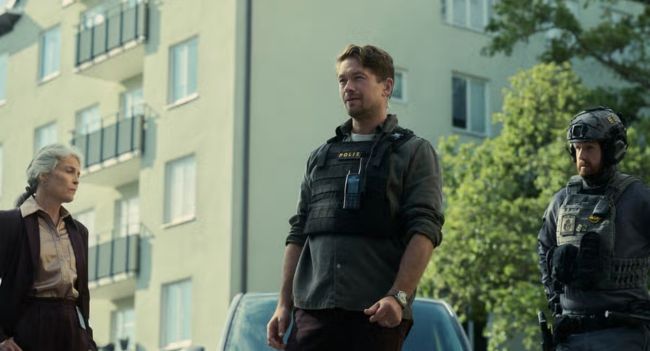
A routine emergency call sends two police officers to an apparently deserted summer house. By the following day, both are dead — and what initially looks like an isolated horror is only the beginning.
That disturbing setup has helped turn Netflix’s Swedish crime thriller Blood Sacrifice (Blodsoffer) into one of the streamer’s breakout hits.
The five-part drama has climbed to third place among Netflix’s most-watched series in the UK, sitting behind new seasons of Outer Banks and Love Is Blind UK at the time of writing. It has also reportedly reached No. 1 in several other countries, including the United States.
Viewers have called it “dark,” “absolutely addictive” and even a “crime thriller masterpiece,” with its compact running time making it dangerously easy to finish in a night or two.
But it is the unsettling opening mystery that makes stopping particularly difficult.

Two officers answer a call — then disappear
The story unfolds during summer in Stockholm, when the long Scandinavian days mean darkness barely arrives.
Against that deceptively bright backdrop, police receive an emergency call reporting what appears to be a home invasion.
Two officers are dispatched to a summer house in the Stockholm archipelago.
When they arrive, however, something is wrong.
The property appears deserted.
There is nobody there — at least, nobody the officers can see.
By the following day, both officers have been found dead.
Their deaths are brutal, and investigators quickly realize they are dealing with something much larger than a burglary gone catastrophically wrong.
More killings follow.
And there appears to be a disturbing connection between the victims.
Someone is targeting police officers.
The killer’s choice of victims changes everything

That pattern immediately raises the stakes.
These are not apparently random murders.
The victims belong to law enforcement, suggesting that whoever is behind the killings may be selecting them for a specific reason.
The investigation becomes a race to understand the motive before another officer is attacked.
At the center of the case is a detective who eventually finds himself turning to someone unusually close to home for assistance: his father, a retired detective.
That decision gives Blood Sacrifice an emotional dimension beyond its central murder mystery.
The series is not only interested in discovering who is killing police officers and why.
It also digs into the complicated relationship between father and son as they are drawn into the same investigation.
A father and son forced together by a horrifying case

The generational relationship has become one of the elements viewers have singled out.
One audience reaction noted that the series contains grim material but also takes a deeper look at the personal relationships surrounding those attempting to solve the murders, particularly the dynamic between father and son.
That gives the investigation another source of tension.
The retired detective brings experience from an earlier generation of policing, while his son is trying to solve a contemporary case that is becoming more dangerous with every new development.
Their shared profession binds them together.
Their personal history makes that collaboration considerably more complicated.
Rather than allowing the murders to become a sequence of anonymous victims and clues, the series keeps returning to the people being affected by the investigation.
From the writer behind Lupin, Hijack and Killing Eve
The pedigree behind the series will immediately be familiar to crime and thriller fans.
Blood Sacrifice comes from British screenwriter George Kay, whose résumé includes several major television thrillers.
Kay created the ITV drama Gone and Apple TV+’s high-pressure Idris Elba thriller Hijack.
He also created Netflix’s international hit Lupin alongside François Uzan.
His previous writing credits include Killing Eve, My Mad Fat Diary and the true-crime drama Litvinenko, while he created the anthology crime series Criminal: UK.
Those projects vary considerably in tone, but many share a fascination with characters being placed under extreme psychological pressure.
Blood Sacrifice takes that experience into Scandinavian crime territory.
Five episodes leave almost no room for filler
Part of the show’s appeal may simply be its size.
The entire story lasts only five episodes, adding up to just over four hours.
That is substantially less commitment than many modern streaming crime dramas require.
There is little opportunity for the mystery to disappear beneath endless secondary storylines.
The opening crime establishes the danger quickly, and the short episode count means the investigation has to keep moving.
For viewers accustomed to eight- or ten-episode mysteries that take several hours to reach their central plot, the difference is noticeable.
One viewer praised exactly that quality, saying the series “starts off fast” because it has only five episodes and remains edgy throughout.
They described the story as unusual, slightly creepy and enjoyable “from start to finish.”
‘You start watching and simply can’t stop’
Other viewers have been even more enthusiastic.
One fan described Blood Sacrifice as “dark, intense, and absolutely addictive,” saying the series kept them hooked from beginning to end.
They praised its atmosphere in particular, recommending it to viewers who enjoy darker crime thrillers.
“For me, it was one of those shows you start watching and simply can’t stop,” they wrote.
Another viewer called the storyline “excellent” and praised the production for maintaining its momentum throughout the short run.
That combination — an immediate mystery, brutal crimes and only five episodes — helps explain why the drama has become such an easy binge.
Finishing “just one more” episode represents a significant portion of the entire series.
Stockholm’s endless summer creates an unusual backdrop
Scandinavian crime dramas are frequently associated with bleak winters, snow-covered landscapes and oppressive darkness.
Blood Sacrifice approaches its setting differently.
The murders unfold during Stockholm’s summer, when daylight stretches late into the evening.
That creates an interesting contradiction.
The crimes themselves are grim, but they occur against a world that refuses to become properly dark.
The Stockholm archipelago also gives the opening investigation an isolated quality as the officers travel to the summer house where the mysterious emergency call originated.
Instead of relying entirely on shadowy alleyways and nighttime streets, the series allows something disturbing to exist in broad Scandinavian daylight.
The violence is not the only darkness
Viewer reactions have warned that the series contains grim scenes, but the violence is only one part of its heavier tone.
The murders force characters to examine personal relationships and histories alongside the evidence.
That becomes particularly important as the father-son storyline develops.
The result sits somewhere between a police procedural and a more personal psychological thriller.
There is a serial threat to uncover, but solving it requires understanding the people connected to the case rather than simply assembling forensic evidence.
That human element helps prevent the story from becoming another conventional hunt for an anonymous killer.
Not everyone was convinced by the finale
The reaction has not been universally glowing.
While many viewers have recommended the series, some have expressed reservations about its ending.
One viewer praised the intriguing mystery, concise episode count, strong cast and well-developed script but described the final episode as “rather lacklustre and anticlimactic.”
They had expected more from the conclusion.
Even so, the same viewer still recommended the series, describing it as a short and easy crime drama to binge.
For anyone starting Blood Sacrifice, that divided reaction may actually add another layer of intrigue.
The journey has attracted widespread praise.
Whether the final destination delivers the same satisfaction appears to depend considerably on the viewer.
Why the series has broken through internationally
Foreign-language crime dramas have long been a significant part of Netflix’s international catalogue, but only some manage to escape their domestic market and climb charts elsewhere.
Blood Sacrifice appears to have done exactly that.
Its premise requires little cultural explanation.
Two officers respond to a mysterious call.
They are murdered.
More police become targets.
A detective must discover why.
That simplicity gives the series an immediate hook, while the Swedish setting and father-son relationship provide the identity needed to distinguish it from countless other serial-killer dramas.
The five-episode format also removes one of the biggest barriers facing unfamiliar international shows.
Viewers can take a chance on it without committing to an enormous season.
A four-hour mystery built for binge-watching
There is something particularly effective about crime dramas that begin with an incident that simply does not make sense.
Why was the emergency call made?
Why was the summer house empty?
What happened to the two officers?
And why are police apparently being hunted?
Those questions arrive almost immediately in Blood Sacrifice.
With only five episodes available to answer them, the series does not have much time to waste.
That may be why viewers have repeatedly described the experience in the same way: they started watching and found it difficult to stop.
Whether its controversial conclusion works for everyone is another matter.
But for crime fans looking for something dark, fast and compact enough to consume in a night or two, Blood Sacrifice has already convinced a large international audience to press play.
Blood Sacrifice (Blodsoffer) is streaming on Netflix.