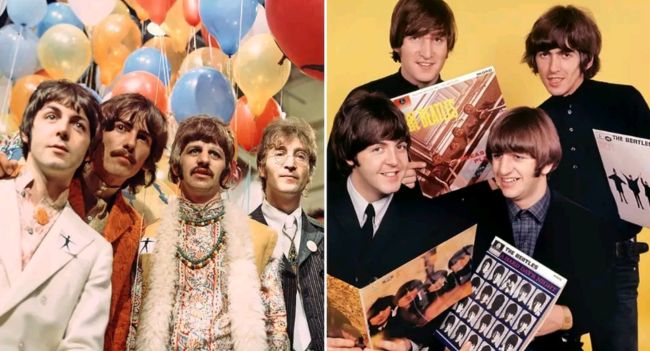

In November 1968, The Beatles released a record so vast and contradictory it felt like several bands arguing inside the same sleeve. Officially titled The Beatles but forever known as The White Album, it sprawled across 30 tracks and revealed a group both creatively fearless and deeply fractured. Most bands would have vanished for a year after something like that. The Beatles didn’t even take a breath.
By January 1969—less than two months later—they were back at work, chasing an idea as bold as it was unrealistic. The plan was simple in theory and brutal in practice: write fourteen new songs from scratch, rehearse them in front of cameras, perform them live within weeks, and record the entire process exactly as it happened. No studio polish. No fixes. Mistakes included. The project was called Get Back, and it was meant to strip The Beatles down to their raw essence.
The urgency was strange, almost defiant. 1968 alone had already produced “Lady Madonna,” the global phenomenon of “Hey Jude,” and a double album that redefined what a rock record could be. Yet there was no victory lap—only forward motion. Much of that momentum came from Paul McCartney, who feared that inactivity would quietly dissolve the band. His drive gave the project its energy, but also exposed growing tensions.
The sessions began at Twickenham Film Studios in cold, early-morning rehearsals that felt more like work shifts than inspiration. Cameras rolled constantly, capturing not just music being born but relationships unraveling. George Harrison grew increasingly frustrated, feeling sidelined despite his rapidly expanding songwriting brilliance. John Lennon, distracted and distant, arrived with Yoko Ono at his side and contributed unevenly. Ringo Starr, ever the quiet stabilizer, sat at the kit watching the band argue around him.
What was meant to be a celebration of togetherness quickly became uncomfortable to witness. Songs like “Get Back,” “Let It Be,” and “The Long and Winding Road” emerged almost miraculously amid the tension, but the environment was draining. Harrison briefly quit the band. Plans for a grand live performance—once imagined as a concert in an exotic location—collapsed one by one.
Eventually, the chaos forced a reset. The band abandoned Twickenham and relocated to the basement studio at Apple Corps headquarters, where the mood lightened slightly. Billy Preston was invited to play keyboards, and his presence transformed the room. Smiles returned. The music tightened. For a moment, The Beatles sounded like a band again.
Then came the solution no one had planned but everyone remembered.
On January 30, 1969, The Beatles climbed to the roof of their Apple building and played live for the last time. No announcement. No tickets. Just amplifiers, winter coats, and songs still warm from creation. London office workers stopped in the streets. Police arrived. History unfolded in real time.
The rooftop concert wasn’t just a performance—it was a statement. Against the odds, The Beatles could still play. Still lock in. Still sound unmistakably like themselves.
Yet the Get Back project never became what it was meant to be. The footage was shelved, the tapes reworked, and the album—eventually released in 1970 as Let It Be—arrived after the band had already broken up. Between those sessions and that release, The Beatles regrouped one final time to make Abbey Road, a carefully crafted farewell that restored beauty where Get Back had exposed fracture.
What makes Get Back legendary isn’t failure—it’s honesty. It documented the end of the greatest band in history not as a dramatic explosion, but as a slow, human unraveling. Creative brilliance colliding with exhaustion, ego, love, and fear of the end.
They didn’t change music history the way they planned. They changed it by showing the truth: even legends struggle to hold it together. And sometimes, the last great moment happens when no one is sure there will ever be another.