Bill Maher Slams Media Over Reluctance to Call 9/11 Attacks ‘Terrorism’
Bill Maher used the 25th anniversary of 9/11 to take aim at what he sees as an increasingly cautious approach by news organizations to the word “terrorism,” arguing that the language used to describe deliberate mass-casualty attacks should not obscure what happened.
During Friday night’s episode of HBO’s Real Time With Bill Maher, which aired on Sept. 11, the comedian and talk-show host reflected on how the language surrounding terrorism has changed since the 2001 attacks.
“There was a war on terror, and we won. And yet, so much has changed since 9/11. For example, back then, we were against the terrorists,” Maher said.
His remarks came as the United States marked 25 years since the Sept. 11, 2001, attacks, in which 2,977 people were killed.

Maher mocks media guidance on the word ‘terrorism’
Maher then turned his attention to journalism organizations and media outlets that have urged reporters to be cautious about using the terms “terrorism” and “terrorist.”
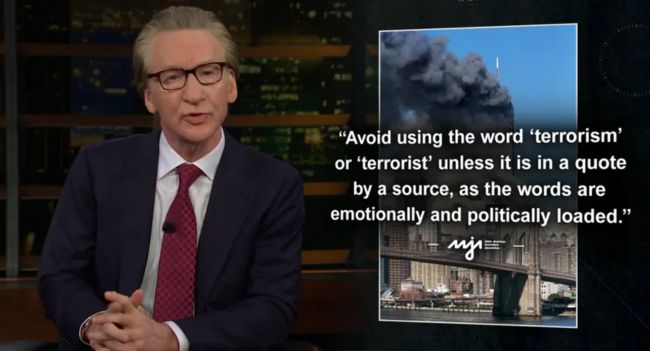
“Now a lot of media outlets don’t even want you to say the ‘T-word’ on the 25th anniversary,” Maher said, referring to journalism associations that, according to him, have encouraged writers to place the word terrorism in quotation marks because it can be considered “emotionally and politically loaded.”
He sarcastically suggested that such organizations were operating from a particular worldview.
“They shared something. Oh, let’s call it a worldview — and it wasn’t astrology,” he said.
Maher’s comments also referenced the Canadian Broadcasting Corporation, which recently faced criticism over editorial guidance concerning the use of the term “terrorism” when describing the 9/11 attacks. The CBC subsequently changed its policy to allow the attacks to be directly described as terrorism.

‘What should we call it then?’
Maher continued by poking fun at the idea that the attacks should be described without directly using the word terrorism.
“What should we call it then — unruly passengers,” he quipped.
“A wrong turn, taken at the Chrysler Building,” he added, drawing applause from the studio audience.
He also criticized the BBC over its approach to the word “terrorist,” pointing to the broadcaster’s argument that the term can become “a barrier rather than an aide to understanding.”
“You know, it’s really a barrier to understanding lying,” Maher responded.
The BBC has previously explained that it generally avoids using “terrorist” in its own voice because it considers the term loaded and instead attributes such descriptions to governments or other sources.
Why news organizations are cautious with the term
The debate Maher raised reflects a broader issue in journalism: when should reporters themselves use the words “terrorism” and “terrorist,” rather than attributing those descriptions to authorities?
The Poynter Institute examined the issue after the FBI described the January 2025 attack in New Orleans, which killed at least 10 people, as an “act of terrorism.” Its guidance notes that the Associated Press generally avoids independently labeling someone a “terrorist,” instead favoring descriptions of the specific actions involved and citing law enforcement or other credible authorities when using the term.
The AP’s guidance also recognizes an important distinction for historical events. Poynter has noted that journalists following AP style should attribute the terms “terrorism” or “terrorist” to authorities or other sources, except when discussing significant historical events that are widely acknowledged as terrorist actions.
That distinction helps explain why terminology surrounding 9/11 remains a particularly sensitive subject. The attacks have long been described as terrorist attacks in mainstream historical and journalistic accounts, while debates continue over how the term should be applied to more recent or politically disputed acts of violence.
Maher’s monologue ultimately focused on that tension, challenging the idea that avoiding the word “terrorism” necessarily produces clearer reporting. His remarks came as Americans commemorated the victims of 9/11 and reflected on an event whose consequences continue to shape the country 25 years later.