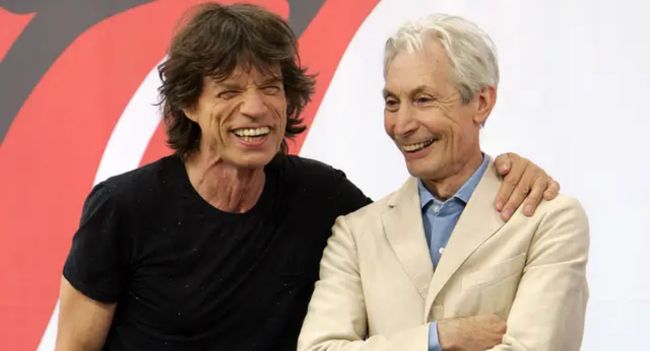
Mick Jagger’s Wordless Tribute to Charlie Watts Said More Than Words Ever Could

Mick Jagger had spent nearly six decades making music alongside Charlie Watts. When the Rolling Stones drummer died on August 24, 2021, Jagger chose an unusually simple way to remember his longtime friend: one photograph, and no words at all.
The image showed Watts smiling behind his drum kit. There was no lengthy farewell and no caption explaining what Charlie had meant to him.
For fans who understood the history between the two men, none was necessary.
Watts died peacefully in a London hospital at the age of 80, surrounded by his family, according to the statement announcing his death. His passing immediately prompted tributes from musicians across generations, many of whom regarded him as one of rock’s most distinctive and influential drummers.
Mick Jagger lets one photograph speak for him
Jagger, then 78, shared the smiling image of Watts across his social media accounts shortly after news of the drummer’s death.
The decision to leave the post without a caption made the tribute particularly poignant. Instead of trying to summarize nearly 60 years of friendship and music, Jagger simply showed Charlie as generations of Rolling Stones fans remembered him — sitting behind the drums.
The response was immediate.
Fans filled the post with condolences and memories. Luciana Gimenez, the mother of Jagger’s son Lucas, was among those who reached out, writing that Charlie would be missed.
For followers of the Stones, the photograph carried decades of history.
Watts had joined the band in January 1963 and remained behind the kit for 58 years. He appeared on every Rolling Stones album during his lifetime and, remarkably, did not miss a concert during those decades with the group. His final performance with the Stones came at Miami’s Hard Rock Stadium on August 30, 2019.
Keith Richards offered an equally understated goodbye
View this post on Instagram
Keith Richards also avoided a long written statement when remembering his bandmate.
Instead, the guitarist posted an image of a drum kit with a “Closed” sign hanging from it.
Like Jagger’s photograph, the simplicity of the image reflected the enormity of what had been lost.
Watts had been the rhythmic foundation beneath Jagger and Richards for almost the entirety of the Stones’ career. His style rarely depended on elaborate solos or theatrical displays. Instead, musicians repeatedly praised his timing, restraint and unmistakable swing.
Rolling Stone later described him as central to the band’s sound and identity, while musicians paying tribute emphasized how much of the Stones’ feel came directly from the man quietly sitting behind the rest of the group.
Paul McCartney, Ringo Starr and Elton John remember Charlie
Jagger and Richards were far from alone in mourning Watts.
Paul McCartney remembered him as a wonderful man and praised him as a “fantastic drummer,” while Ringo Starr sent his love to Watts’ family and said the drummer would be missed.
Elton John described Watts as the “ultimate drummer,” while also remembering his famous sense of style and the pleasure of his company.
Members of The Who also paid tribute. Pete Townshend remembered Watts as fundamentally a jazz drummer whose approach helped give the Rolling Stones their distinctive swing.
Those tributes reflected something musicians had understood for decades: Watts might have been one of the least flamboyant personalities in one of rock’s most flamboyant bands, but his contribution was impossible to replace.
The heartbeat behind Mick Jagger’s moves
View this post on Instagram
In the days after Watts’ death, Metallica drummer Lars Ulrich offered a particularly striking explanation of his importance.
Watching old Rolling Stones footage, Ulrich noted that audiences might think they were moving along with Jagger, but Jagger himself was moving to Watts’ drumming. In that sense, the rhythm that powered the frontman’s famous stage presence began behind the drum kit.
Jagger would later express something similar himself.
Speaking after the Stones returned to touring, he called Watts the band’s “heartbeat” and remembered him as an exceptionally steady presence both musically and personally. He also spoke about their friendship away from the stage, recalling that they spent time together attending football and cricket matches and shared interests beyond music.
The absence followed them into rehearsals, too.
Jagger said the band would find themselves remembering how Charlie might have reacted to a particular situation or what he would have played. After so many concerts, recording sessions and tours together, learning to work without him felt deeply strange.
The Stones eventually returned to the stage without him

Before his death, Watts had already withdrawn from the Stones’ upcoming tour because of health issues, with Steve Jordan selected to fill in.
According to Jagger, Watts himself had encouraged the group to continue rather than stop because of him.
When The Rolling Stones officially launched their 2021 No Filter Tour in St. Louis the following month, they opened the night with a video montage dedicated to Watts.
Jagger acknowledged how emotional it was to see Charlie on the screens and told the audience that it was the first tour the Stones had ever undertaken without him. He and Richards then dedicated the tour to their late bandmate.
The concert continued, but Watts’ absence remained visible until the final moments. When the musicians came forward for their traditional bow, only Jagger, Richards and Ronnie Wood stood together where four men had once appeared. A photograph of Watts then filled the screens as the audience applauded.
A drummer whose absence could never be hidden

Watts was survived by his wife Shirley, daughter Seraphina and granddaughter Charlotte. The announcement of his death remembered him not only as an extraordinary musician but as a cherished husband, father and grandfather.
The Rolling Stones would continue performing, with Jordan taking on the formidable responsibility of sitting behind the drum kit.
But Jagger’s first public reaction to losing Charlie remains one of the simplest and most affecting tributes.
A smiling drummer. His kit in front of him. No caption.
After nearly 60 years together, perhaps there simply wasn’t a sentence large enough for what Mick Jagger had lost.